A practical guide to creating, pricing, and selling advertising and sponsorship opportunities within your business
Every day, local businesses attract valuable audiences. Customers visit restaurants, breweries, gyms, golf simulators, family entertainment centers, retail stores, and countless other businesses because they are interested in what those places offer. That attention has value, not just to the business itself, but also to other local organizations looking to reach the same audience.
While large brands have long invested in sponsorships at stadiums, arenas, and events, many local businesses overlook the advertising opportunities already within their own walls. Digital displays, waiting areas, windows, community events, loyalty programs, and everyday customer interactions can become thoughtful, non-intrusive ways to connect advertisers with highly relevant audiences.
This field guide explains how to identify those opportunities, understand what makes them valuable, price them responsibly, and build advertising and sponsorship programs that enhance the customer experience while creating new sources of revenue.
Chapter 2: Why businesses buy local advertising
Understanding your advertising inventory
Before deciding what to sell or how much to charge, it helps to understand why businesses invest in local advertising in the first place.
The answer is not simply visibility. Businesses advertise because they want to reach the right people at the right time, in the right place.
Every business already has an audience. The real question is whether that audience is valuable to someone else.
A neighborhood gym attracts people interested in health and fitness. A golf course attracts recreational golfers, business professionals, and tournament participants. A brewery attracts customers looking to socialize. A family entertainment center attracts parents planning birthdays and family activities.
To an advertiser, those audiences may be more valuable than reaching thousands of random people online.
Advertisers buy audiences, not signs
It is easy to think of advertising as selling wall space, digital screens, or banners. In reality, advertisers are buying access to the people who see those assets.
Imagine two opportunities:
- A sign viewed by 10,000 random people who have little interest in the advertiser's product.
- A sign viewed by 500 people who are highly likely to become customers.
In many cases, the smaller audience creates more value because it reaches the people most likely to take action. For many local businesses, relevance matters more than sheer audience size.
Local businesses offer highly relevant audiences
One of the greatest advantages local businesses have is context. People choose to visit your business for a reason. They are already engaged in an activity, pursuing a hobby, solving a problem, or spending time with family and friends. That environment helps advertisers reach people at a moment when their message feels more natural and memorable.
For example:
- A physical therapist advertising inside a fitness center.
- A home inspector advertising at a local hardware store.
- A birthday-party service advertising inside a family entertainment center.
- A financial advisor sponsoring a golf tournament.
These partnerships feel relevant because they align with why customers are already there.
Attention matters
Not every advertisement receives the same amount of attention. Someone quickly scrolling through social media may see dozens of advertisements in a few minutes. Customers waiting for food, watching a game, relaxing at a brewery, or spending several hours at a golf course often have more opportunities to notice the environment around them.
Research concerning attention and contextual relevance suggests that real-world advertising can create stronger opportunities for notice and recall than rapidly viewed display advertising, particularly when the message fits the surrounding environment. Results vary by venue, audience, placement, and creative, but the central principle is straightforward:
Relevant audiences paying genuine attention are often more valuable than large audiences giving very little attention.
Trust and familiarity add value
Advertising can also benefit from the reputation of the place where it appears. Customers often trust the businesses they choose to visit. When advertising is presented thoughtfully within those environments, it may feel more like a local recommendation than an interruption.
That does not mean every customer will immediately make a purchase. It does mean that advertising within trusted community spaces may benefit from repeated exposure and increased familiarity over time.
Reducing advertising waste
Many forms of advertising reach large numbers of people who are unlikely to become customers. Local advertising can focus on the people most likely to care about the advertiser's product or service.
A youth soccer program may have little interest in advertising to commuters passing a highway billboard. Advertising inside a family entertainment center or recreation facility could place the same message directly in front of parents planning activities for their children.
Reaching fewer, but more relevant, people can create better value than reaching many people with little connection to the advertiser.
What this means for your business
You do not need millions of visitors to create valuable opportunities. Ask:
- Who visits my business?
- Why are they here?
- How much time do they spend here?
- What other businesses would want to reach these customers?
Those answers form the foundation of every successful advertising and sponsorship program.
Want to learn more?
This field guide focuses on practical guidance for business owners. A future companion research paper, The Economics of Local Advertising: Why Targeted Real-World Audiences Create Value, will examine attention, contextual relevance, advertising waste, audience assessment, and pricing methodologies in greater detail.
Chapter 3: Identifying your advertising and sponsorship opportunities
Once you understand the value of your audience, the next step is identifying the places, experiences, and touchpoints advertisers may be interested in supporting.
Many business owners assume advertising means hanging a banner on a wall. In reality, almost every business interacts with customers in dozens of ways throughout a typical visit. Each interaction creates an opportunity for another business to increase visibility, build awareness, or support the customer experience.
Some opportunities are physical, such as signs or digital displays. Others are experiential, such as events or customer programs. A website, newsletter, reservation flow, or loyalty program may also provide useful ways for local businesses to reach your audience.
Collectively, these opportunities are your advertising inventory: the collection of assets your business can make available for advertising or sponsorships.
The goal is not to sell everything. Identify opportunities that fit naturally within the business while maintaining a positive customer experience.

Exterior opportunities
The outside of your business is often the first thing customers see, making it a useful place to build awareness for local advertisers.
- Exterior walls
- Windows and storefront graphics
- Sidewalk signs
- Patio barriers or fencing
- Parking-lot signage
- Outdoor digital displays
- Vehicle wraps
- Entryways
- Landscaping features
- Seasonal decorations
- Building entrances
- Monument signs
Interior opportunities
Customers typically spend more time inside the business than outside it, creating opportunities for repeated exposure.
- Digital screens or televisions
- Waiting areas
- Seating areas
- Countertops
- Menu boards
- Table tents
- Wall graphics
- Checkout areas
- Product displays
- Floor graphics
- Directional signage
- Charging stations
- Wi-Fi login pages
Programs and experiences
Some of the most valuable sponsorship opportunities are not physical. Businesses frequently create experiences advertisers may be eager to support because they build goodwill and connect with customers in meaningful ways.
- Community events
- Live entertainment
- Trivia nights
- Youth programs
- Leagues and tournaments
- Customer-appreciation events
- Holiday celebrations
- Workshops
- Educational seminars
- Loyalty programs
- Membership programs
- Charity fundraisers
Digital opportunities
Digital touchpoints can complement physical advertising and sponsorships.
- Website sponsorships
- Email newsletters
- Event-registration pages
- Mobile applications
- Online reservation systems
- Customer portals
- Social-media partnerships
- Digital coupons
- Confirmation emails
Packaging creates more value
Advertisers may prefer packages that combine several related opportunities into one partnership. A brewery might combine digital screens, weekly trivia, newsletter recognition, social promotion, and table signage.
Bundling can create more value for both the advertiser and business while simplifying the sales process.
Start small
You do not need dozens of opportunities on day one. Begin with one or two well-managed placements or sponsorships, then expand as the process becomes easier to operate and measure.
Chapter 4: Creating advertising and sponsorship packages
After identifying the opportunities within your business, the next step is deciding how to offer them.
Some opportunities can be sold individually. In many cases, advertisers receive more value when related touchpoints are combined into a simple package.
A package brings multiple benefits together around one audience, activity, or objective. It should clearly explain:
- Who the advertiser will reach
- Where its message will appear
- How often customers may encounter it
- What the partnership includes
- How long it lasts
- What the advertiser must provide
The goal is not to make a package appear large by filling it with every available asset. The goal is to create one understandable offering in which every component serves a purpose.
Begin with the advertiser's goal
Different advertisers may want different outcomes from the same venue. One may want broad local visibility. Another may want direct access to families, professionals, fitness enthusiasts, or league participants. A third may want to support a trusted local program and build goodwill.
Common goals include:
- Increasing awareness among nearby customers
- Reaching a specific audience
- Promoting a new location, service, or event
- Generating visits, inquiries, or registrations
- Becoming associated with a trusted business
- Supporting a league, program, or community activity
- Gaining category exclusivity
- Building repeated recognition over several months
Combine opportunities that reinforce one another
A family-entertainment package might include entrance recognition, an interior digital display, birthday-program sponsorship, confirmation-email inclusion, and a post-visit customer offer.
Each element serves a role: awareness, reinforcement, contextual relevance, and continued engagement. A collection of unrelated placements may create more volume, but not necessarily more value.
Common package structures
Single-placement package
A straightforward opportunity built around one asset.
- Storefront window
- Waiting-room display
- Television or digital screen
- Exterior panel
- Point-of-sale placement
Multi-placement package
A coordinated group of physical or digital placements offered for one campaign period.
- Entrance recognition
- Interior screens
- Tabletop displays
- Email-newsletter inclusion
Event or program sponsorship
A partnership connected to an activity rather than one advertising surface.
- Trivia-night sponsor
- Tournament sponsor
- League sponsor
- Workshop sponsor
- Birthday-program partner
Recurring partnership
A monthly, seasonal, or annual agreement that provides consistent exposure.
- Ongoing screen placement
- Recurring newsletter recognition
- Monthly event sponsorship
- Limited category exclusivity
Presenting or exclusive partnership
A higher-level package giving one advertiser a more prominent role.
- Presenting partner
- Exclusive healthcare partner
- Official birthday-party partner
- Preferred financial-services partner
Match the package to the audience
A package should reflect why customers visit the business and which related needs they may have.
A gym, for example, might offer a wellness partnership combining fitness-area screens, member communications, educational workshops, and event sponsorship. Each benefit helps the advertiser reach health-conscious customers at a relevant moment.
A brewery might build a social-events package around trivia nights, patio recognition, interior displays, and email promotion. A gaming venue could combine tournament naming, activity-area displays, registration communications, and prize support.
Service businesses can use the same principle. A customer-information package might combine waiting-room media, appointment communications, and useful educational content.
The stronger the connection between the audience, environment, and advertiser, the easier the package is to understand and sell.
Define exactly what is included
- Number and location of placements
- Display size or format
- Campaign or agreement dates
- Frequency of digital rotation
- Event or program recognition
- Email or website placement
- Social-media commitments
- Activation or booth rights
- Category exclusivity
- Creative requirements
- Production responsibilities
- Reporting provided
- Renewal terms
Separate guaranteed benefits from estimates
Installation periods, number of screens, newsletter placements, event recognition, and booth rights may be guaranteed. Attention, recall, sales, and website traffic may only be estimated.
Present estimates honestly and explain how they were calculated. Reliable delivery is more valuable than exaggerated promises.
Keep the customer experience in mind
A package may still be a poor fit if it:
- Creates visual clutter
- Interrupts normal customer activity
- Promotes an inappropriate product
- Conflicts with existing partners
- Reduces trust
- Makes the venue feel overly commercialized
Start with three simple offerings
One individual placement
A window, screen, waiting area, or other clearly defined asset.
One multi-touch package
A combination of compatible physical and digital exposure.
One event or recurring sponsorship
A partnership connected to a league, program, tournament, or customer activity.
Chapter 5: Pricing your advertising and sponsorship opportunities
Pricing is often the most difficult part of creating an advertising or sponsorship program. Advertising terms such as CPM, impressions, reach, and market rate can make the process feel more technical than it needs to be.
The goal is not to discover one mathematically perfect price. A practical price should reflect value, cover delivery costs, remain understandable, and leave room to learn from actual demand.
Begin with the opportunity, not the price
A price has little meaning without knowing what is included, where it appears, who is likely to see it, how long it lasts, how often it may be encountered, whether exclusivity is included, and who pays production costs.
The main factors that influence price
A simple five-step pricing process
Establish the cost floor
Calculate the minimum amount required to deliver the opportunity without losing money.
Estimate relative strength
Review audience relevance, visibility, dwell, repeat exposure, context, interaction, duration, and exclusivity.
Review comparable alternatives
Compare what else an advertiser could purchase with a similar budget.
Create a testing range
Document a cost floor, minimum acceptable price, pilot price, standard target, and premium range.
Test the market
Use qualified interest, negotiation, demand, delivery effort, and renewals as pricing signals.
Step 1: Establish the cost floor
| Cost item | Example amount |
|---|---|
| Printing and production | $100 |
| Installation and removal | $75 |
| Administrative time | $50 |
| Reporting and photography | $25 |
| Contingency | $25 |
| Estimated fulfillment cost | $275 |
Step 2: Estimate the opportunity's relative strength
Use the appropriate SiiqIQ Opportunity Rating or a simple one-to-five review of the most relevant factors. The rating is not a price calculator. It helps explain why one opportunity may deserve more attention than another.
Step 3: Review comparable alternatives
- Local event sponsorships
- Youth sports packages
- Neighborhood publications
- Chamber or association sponsorships
- Nearby billboards
- Direct mail
- Paid social campaigns
- Local newsletter placements
- Other venue advertising
Step 4: Create a testing range
| Pricing boundary | Example amount |
|---|---|
| Cost floor | $275 |
| Minimum acceptable | $400 |
| Pilot asking price | $500 |
| Standard target | $650 |
| Premium range | $800+ |
Step 5: Test the market
| Market response | Possible interpretation |
|---|---|
| Several qualified advertisers want the same opportunity | The price may be low, or scarcity may justify carefully defined exclusivity. |
| Advertisers like the audience but decline the package | The benefits, price, or term may need improvement. |
| Advertisers consistently say the price is too high | The price, proof, targeting, or explanation may need revision. |
| A sponsor renews without hesitation | The opportunity likely created sufficient value. |
| A low-priced package requires substantial work | The opportunity may be unprofitable despite demand. |
| No qualified prospects respond | The issue may be targeting or outreach rather than price alone. |
Where CPM fits—and where it does not
If an advertiser pays $500 for an estimated 25,000 impressions, the estimated CPM is $20. CPM can help compare media options, but it does not fully capture sponsorship association, category exclusivity, event participation, trusted venue context, interaction, or community goodwill.
Use CPM as a reasonableness check, not the sole pricing method.
Pricing packages
| Component | Example amount |
|---|---|
| Digital screens | $400 |
| Event sponsorship | $500 |
| Newsletter placement | $150 |
| Tabletop display | $200 |
| Standalone total | $1,250 |
| Package adjustment | −$150 |
| Category exclusivity | +$250 |
| Additional fulfillment | +$100 |
| Package starting price | $1,450 |
Pilot pricing
The three-month pilot rate is $450 per month. The anticipated standard rate after the pilot is $600 per month, subject to delivery review and market response.
Discounts and negotiation
Establish discount rules before sales conversations begin. When an advertiser cannot afford the full package, consider reducing the benefits rather than automatically reducing the price.
- Shorten the term
- Remove exclusivity
- Use one screen instead of three
- Reduce digital promotion
- Remove event activation
- Offer a smaller entry package
Avoid these common pricing mistakes
- Copying another business's price without comparing the full offer
- Pricing only from foot traffic
- Starting too low because the asset was previously unused
- Ignoring fulfillment costs
- Including unlimited changes
- Discounting without receiving something in return
- Treating the Opportunity Rating as a price
- Promising results that cannot be verified
Chapter 6: Finding local advertisers
Creating advertising opportunities is only half of the process. The next step is finding businesses that genuinely benefit from reaching your audience.
Which businesses would benefit from reaching the people already visiting my business?
Successful partnerships are built on audience alignment rather than simply selling available space.
Think in categories, not individual businesses
A brewery can ask what kinds of businesses benefit from reaching brewery customers. That exercise may produce financial advisors, real-estate professionals, insurance agencies, restaurants, transportation providers, event venues, tourism organizations, dealerships, contractors, and festivals.
Start with your existing customers
- Which businesses regularly visit?
- Who hosts events here?
- Which companies reserve private rooms?
- Which organizations sponsor community events?
- Which businesses already recommend us?
- Which vendors serve our customers?
Follow the customer journey
| Before visiting | During the visit | Afterward |
|---|---|---|
| Athletic clothing, water bottles, sports nutrition, parking, and transportation | Food and beverages, equipment rentals, lessons, and merchandise | Restaurants, physical therapy, massage, outdoor retail, travel, and fitness services |
Businesses that share the same audience
| Business | Potential advertising partners |
|---|---|
| Brewery | Restaurants, transportation, concerts, festivals, and hotels |
| Fitness center | Physical therapy, nutrition, athletic apparel, and healthy restaurants |
| Golf course | Financial services, automotive, real estate, and travel |
| Family entertainment center | Birthday services, youth sports, toy stores, dentists, and children's education |
| Coffee shop | Coworking, bookstores, local events, and professional services |
| Bowling center | Pizza restaurants, arcades, youth organizations, breweries, and party planners |
Think beyond physical businesses
- Colleges and universities
- Nonprofit organizations
- Hospitals
- Local governments
- Tourism agencies
- Business improvement districts
- Chambers of commerce
- Community foundations
- Utility companies
- Public transportation agencies
- Local employers
- Workforce-development organizations
Look for life events
- Buying a home
- Starting a business
- Having children
- Planning a wedding
- Going to college
- Retiring
- Beginning a fitness journey
- Caring for aging parents
- Moving into the community
- Planning vacations
Who should not advertise?
- Advertisers that conflict with business values or policies
- Advertisers that create customer confusion
- Direct competitors to the primary business
- Advertisers that reduce trust
- Advertisers making misleading or questionable claims
- Advertisers that create an overwhelming environment
Build an advertiser prospect list
- Business name
- Industry
- Contact person
- Website
- Why the audience is a good fit
- Potential sponsorship ideas
- Date contacted
- Current status
- Follow-up date
Matching opportunities to advertisers
| Opportunity | Often attractive to |
|---|---|
| Waiting-room displays | Healthcare, insurance, and home services |
| Digital screens | Restaurants, retailers, and entertainment venues |
| League sponsorships | Financial services, sporting goods, healthcare, and community organizations |
| Tournament sponsorships | Automotive, banking, insurance, and professional services |
| Event sponsorships | Food and beverage businesses, tourism organizations, and local employers |
| Loyalty programs | Restaurants, retailers, and service businesses |
| Membership sponsorships | Financial institutions, healthcare, and wellness businesses |
| Community events | Businesses seeking broad local visibility and goodwill |
Use data to strengthen recommendations
- Which advertisers renew?
- Which sponsorships sell first?
- Which audiences attract the most interest?
- Which events consistently generate inquiries?
- Which industries respond most often?
- Which packages produce the strongest value?
Think like a matchmaker
Why would this advertiser benefit from reaching this audience?
If you can answer that question clearly, you are not simply selling space. You are helping two local businesses create a mutually beneficial partnership.
In the next chapter, we will examine how to establish clear agreements, deliver what was promised, document results, and create partnerships advertisers want to renew.
Chapter 7: Managing successful advertising and sponsorship partnerships
A good partnership does not end when the contract is signed.
Selling an opportunity is only the beginning. Strong programs deliver what was promised, communicate consistently, and create relationships advertisers want to renew.
Set clear expectations before anything begins
- Advertising or sponsorship assets included
- Campaign or sponsorship dates
- Installation and removal schedules
- Creative specifications
- Production responsibilities
- Payment terms
- Approval process
- Reporting expectations
- Contact information
- Procedures for unexpected changes
Put it in writing
Even relatively small partnerships benefit from a written agreement documenting the parties, deliverables, dates, price, payment, creative deadlines, installation, maintenance, cancellation, interruption, and renewal.
Deliver exactly what you sold
If the agreement promised newsletter placements, recognition at every event, three months on a display, or sponsor acknowledgement during every program, those commitments should be delivered consistently.
Communicate throughout the partnership
- Installation photographs
- Campaign launch confirmation
- Event reminders
- Attendance estimates
- Schedule changes
- Weather impacts
- Completed milestones
Document delivery
- Photographs
- Installation dates
- Campaign schedules
- Attendance estimates
- Event participation
- Newsletter delivery
- Website screenshots
- Social-media posts
- Invoices
- Communications
Measure success according to the objective
- Brand awareness
- Customer inquiries
- Event participation
- Community visibility
- Membership growth
- Website traffic
- QR-code scans
- Coupon redemptions
- Repeat attendance
Many local opportunities focus more on long-term awareness than immediate sales. Success should be measured according to the agreed objective rather than one universal metric.
Handle changes quickly and fairly
- Communicate early
- Explain the issue
- Offer alternatives
- Document agreed changes
- Keep the sponsor informed
Think beyond one campaign
A sponsor that begins with one opportunity may later expand into additional locations, seasonal campaigns, community events, digital placements, presenting sponsorships, or exclusive partnerships.
Renewals begin earlier than you think
Begin renewal conversations while the partnership is still active. For annual agreements, that may mean 60 to 120 days before the term ends.
Learn from every partnership
- Which opportunities generated the most interest?
- Which sponsors renewed?
- Which assets were difficult to sell?
- Which audiences responded best?
- Which packages were easiest to explain?
- Which reporting metrics mattered most?
Partnership lifecycle
Discover opportunity
Initial conversation
Agreement
Creative and installation
Campaign active
Reporting
Renewal discussion
Expanded partnership
Chapter 8: Common mistakes to avoid
Mistake 1: Trying to sell everything
Too much advertising can distract from the customer experience and reduce the value of every opportunity. Strong programs are carefully curated.
Mistake 2: Selling signs instead of audiences
Advertisers are not buying a television screen or lobby wall. They are buying access to the people who encounter those assets.
Mistake 3: Underpricing everything
Pricing should reflect value, comparables, fulfillment costs, and market feedback rather than fear or wishful thinking.
Mistake 4: Creating confusing packages
Packages should tell one clear story based on a shared audience, common objective, or consistent customer experience.
Mistake 5: Ignoring production costs
Printing, installation, design, maintenance, electricity, staff time, event support, replacement graphics, and reporting all require resources.
Mistake 6: Promising results you cannot measure
Report observable delivery and activity. Be cautious about guaranteeing sales, ROI, customer acquisition, or brand awareness.
Mistake 7: Forgetting existing customers
Advertising should enhance, not compete with, the primary purpose of the business.
Mistake 8: Waiting too long to discuss renewals
Begin renewal conversations while the partnership is still active and the sponsor can review results and reserve future opportunities.
Mistake 9: Failing to keep an updated inventory
Treat the advertising inventory as a living document. Review availability, pricing, events, digital channels, and operating requirements regularly.
Mistake 10: Waiting until everything is perfect
Many successful programs begin with a handful of thoughtfully managed opportunities and improve over time.
Self-assessment
Is your advertising program ready?
- □ I know who my audience is.
- □ I know why advertisers would value that audience.
- □ I have identified my advertising inventory.
- □ My opportunities fit naturally within the customer experience.
- □ My pricing is based on value, not guesswork.
- □ My packages are organized around sponsor objectives.
- □ I have a written agreement template.
- □ I know how I will report results.
- □ I have a renewal process.
- □ I can explain my opportunities in one minute.
You are ready to begin selling.
You have a solid foundation but should strengthen weaker areas before expanding.
Return to the earlier chapters and build the program one step at a time.
Chapter 9: Frequently asked questions
Can any business sell advertising or sponsorships?
Almost any business that attracts customers regularly may have opportunities. The key question is whether the business consistently attracts an audience another organization would value.
What is the difference between advertising and sponsorship?
Advertising generally involves purchasing a defined promotional placement. Sponsorship creates a broader relationship with an event, program, experience, or audience and may include recognition, activation, advertising, and other benefits.
How much should I charge?
There is no universal price. Consider audience relevance, visibility, customer dwell, repeat exposure, context, exclusivity, duration, production costs, comparable opportunities, and advertiser demand.
Do I need a large audience?
No. Many advertisers would rather reach several hundred highly relevant customers than thousands of people with little connection to their products or services.
Should I offer discounts?
Discounts should be intentional and tied to longer commitments, reduced benefits, multiple locations, early renewal, or another meaningful concession.
How many advertising opportunities should I offer?
Start with a small number that fit the business naturally and can be delivered consistently.
Should I sell individual opportunities or create packages?
Both approaches have value. Individual placements work well for focused campaigns and smaller budgets. Packages can create stronger value by combining compatible touchpoints.
What kinds of businesses usually advertise locally?
Potential advertisers include healthcare providers, financial institutions, insurance agencies, real-estate professionals, home-service companies, automotive businesses, schools, youth organizations, nonprofits, restaurants, retailers, professional services, tourism businesses, and entertainment venues.
Should advertisers receive exclusivity?
Sometimes. Define the exact category, assets, term, territory, and exceptions. Broad exclusivity can unnecessarily limit future revenue.
Who creates the advertising artwork?
The advertiser, business, or an outside designer may create it. The agreement should identify responsibility for design, approvals, revisions, production, installation, and removal.
How long should agreements last?
Terms may range from one-day event sponsorships to monthly campaigns, seasonal programs, annual partnerships, or multi-year naming agreements.
How do I measure success?
Measure success according to the objective established at the beginning of the partnership. Useful measures may include campaign duration, attendance, estimated impressions, QR scans, website traffic, coupon redemptions, event participation, newsletter delivery, installation photographs, advertiser satisfaction, and renewals.
What should every advertising agreement include?
Identify the included opportunities, campaign dates, pricing, payment terms, production responsibilities, creative specifications, installation and removal, cancellation, reporting, interruption procedures, and renewal process.
How do I find advertisers?
Start with businesses that already serve similar customers. Existing vendors, neighboring businesses, community organizations, event sponsors, chambers, and regional employers are often strong prospects. Publishing opportunities through a marketplace can also make them easier to discover.
Can I start with only one advertising opportunity?
Yes. Starting small allows the business to refine pricing, agreements, reporting, and fulfillment before expanding.
What if no one buys immediately?
Early conversations provide useful feedback about pricing, audience fit, package structure, timing, messaging, and perceived value. Use that information to improve the offer.
Where should I begin?
Start by understanding your audience. Then inventory existing opportunities, evaluate their strengths, organize them into simple packages, establish clear pricing and agreements, and begin with one or two well-managed partnerships.
Chapter 10: Next steps and resources
You have now worked through the complete process:
- Understanding why businesses buy local advertising
- Identifying the opportunities within your business
- Organizing those opportunities into meaningful packages
- Pricing them consistently
- Finding advertisers
- Managing successful partnerships
Start small
- One digital display
- One event sponsor
- One community partnership
- One recurring package
Build your inventory
Treat your advertising inventory as a living document. Add new opportunities, retire those that no longer fit, and update pricing as the business changes.
Continue learning
SiiqIQ Research is developing additional guidance covering:
- Pricing advertising opportunities
- Sponsorship strategy
- Naming rights
- Opportunity scoring
- Advertising measurement
- Local advertising economics
- Outdoor advertising
- Venue sponsorships
- Community advertising
- Buyer guides
Free planning workbook
Build your local advertising and sponsorship program
Use the companion workbook to document your audience, inventory opportunities, calculate directional ratings, build packages, plan pricing, track advertisers, manage agreements, document delivery, and prepare for renewals.
Make your opportunities easy to discover
Potential advertisers first need to know those opportunities exist. Whether you promote them through your own website, local relationships, community organizations, or marketplaces such as SIIQ, making inventory easier to discover increases the likelihood of finding the right advertising partners.
Advertising program roadmap
Understand your audience
Inventory your opportunities
Score and prioritize assets
Build sponsorship packages
Establish pricing
Prepare agreements
Publish your opportunities
Find advertisers
Deliver and report
Renew and improve
Final thoughts
Every business already has something valuable, not simply because it owns walls, windows, televisions, or digital screens, but because it earns the attention of customers every day.
The goal is not to turn your business into an advertising platform. It is to create partnerships that strengthen the business while improving the customer experience.
Have advertising or sponsorship opportunities to offer?
SIIQ helps local businesses make real-world advertising spaces and sponsorship opportunities easier for relevant advertisers to discover.
Sources and methodology
External research
This field guide is intended as a practical operating guide. Its central frameworks, examples, opportunity categories, package structures, pricing process, partnership lifecycle, and program-readiness checklist were developed by SIIQ for educational and planning purposes.
Future companion research papers will provide detailed source support for claims involving attention, contextual relevance, viewability, estimated impressions, advertising waste, pricing methodologies, and campaign measurement. Those papers should link to original research publishers and clearly distinguish measured findings from SIIQ-created analysis.
SIIQ-created analysis
The local-business opportunity map, advertising-inventory framework, packaging guidance, pricing process, advertiser-matching framework, partnership lifecycle, readiness diagnostic, and workbook structure were developed by SIIQ for educational and planning purposes.
Opportunity Ratings are directional comparisons of opportunity characteristics. They are not derived from observed campaign results and do not guarantee impressions, engagement, advertiser demand, pricing, revenue, or renewal.
Audience, attendance, exposure, and engagement estimates should be described as illustrative unless supported by a clearly identified measurement process. Pricing examples are planning assumptions rather than marketwide benchmarks.
Businesses should replace generalized assumptions with their own customer counts, operating hours, placement observations, production costs, campaign records, advertiser feedback, and renewal behavior whenever available.
Last reviewed: August 2026

How Municipalities, Business Districts, and Tourism Organizations Can Build Sustainable Sponsorship Programs and Generate Revenue
Learn how municipalities, business improvement districts, tourism organizations, parks departments, and economic development agencies can inventory, evaluate, package, price, and manage sponsorship opportunities while building sustainable community partnerships.
Read guide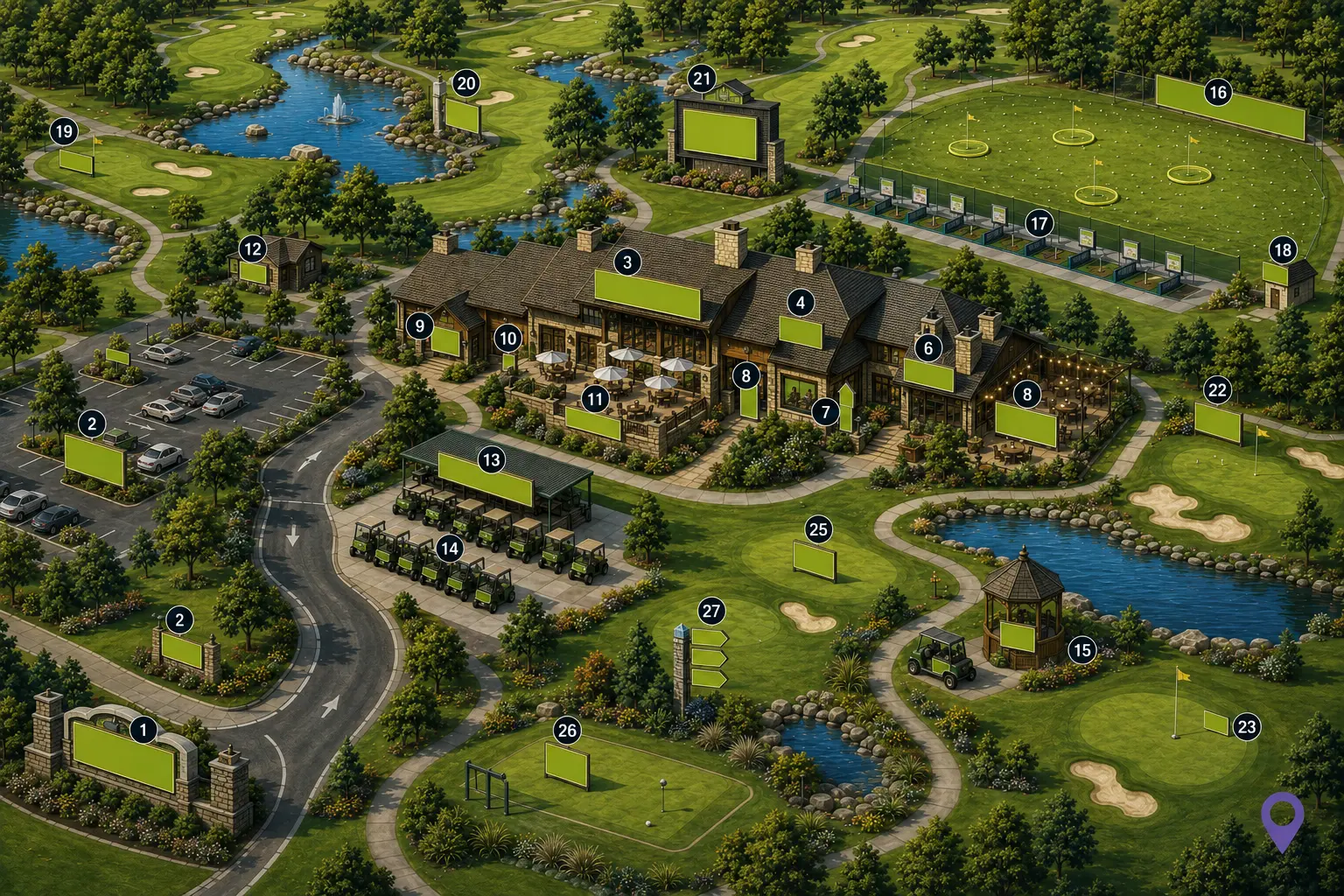
How Golf Courses Can Generate Advertising Revenue
A practical guide to identifying, evaluating, packaging, and pricing advertising and sponsorship opportunities across a golf course.
Read guide