Supporting community places and programs requires new revenue strategies
Municipalities, business improvement districts, tourism organizations, and other community-serving organizations are being asked to do more than ever before. Downtown revitalization, public events, visitor attraction, recreation programming, beautification projects, economic development, and placemaking initiatives all require ongoing investment. At the same time, many organizations continue to operate within increasingly constrained budgets.
Grants, assessments, memberships, and tax revenues remain important funding sources. However, these sources may be restricted to specific purposes, dependent on annual appropriations, or subject to changes in economic conditions. Many communities are therefore exploring complementary revenue strategies that can support public programs without replacing their existing funding models or changing their core mission.
One of the largest opportunities already exists within assets that community organizations manage every day. Public spaces, downtown streets, community events, visitor programs, recreation facilities, seasonal initiatives, digital communications, and local partnerships can all create opportunities for businesses to support the community while increasing their own visibility.
In many cases, these assets already exist. They simply have not been organized into a structured sponsorship program.
This guide examines how municipalities, business improvement districts, tourism organizations, and similar organizations can identify existing sponsorship opportunities, evaluate their relative value, package them into meaningful offerings, and build sustainable programs that benefit both the community and participating businesses.
Why communities leave sponsorship revenue untapped
Research and guidance from organizations including McKinsey & Company, the United Nations Development Programme, Main Street America, and Destinations International highlight several related needs: diversifying community funding, coordinating public and private partners, strengthening downtown organizations, and aligning visitor activity with community goals. 1 2 3 4
The challenge is rarely a complete lack of valuable assets. More often, sponsorship opportunities develop organically across different departments, events, facilities, and partner organizations. A parks department may manage recreation programs, a tourism organization may promote visitor experiences, a downtown organization may coordinate streetscape improvements, and a municipality may oversee public spaces.
Each organization or department may operate successful initiatives independently, yet few communities maintain a unified inventory of sponsorship opportunities across all of these activities. This fragmentation can cause opportunities to be overlooked, inconsistently priced, offered repeatedly to the same businesses, or never presented to potential sponsors at all.
Fragmentation can also make it difficult for a business to understand the complete value of a partnership. A banner program may be managed separately from a festival, visitor guide, recreation program, or downtown newsletter even though all five opportunities may reach overlapping audiences.
Sponsors increasingly seek partnerships that combine physical visibility, digital promotion, community engagement, and demonstrable outcomes. Communities that continue to sell only individual banners or one-time event placements may unintentionally leave larger and more valuable partnership opportunities unrealized.
Four common barriers to sponsorship growth
- Organizational inertia: Existing programs continue to operate as they always have, even when new partnership models could provide additional support.
- Fragmented ownership: Assets are controlled by different departments or organizations with no shared inventory or coordinated outreach process.
- Inconsistent valuation: Pricing may be based on historical amounts, informal negotiations, or what a previous sponsor happened to pay.
- Limited reporting: Sponsors receive little documentation showing what was delivered, who was reached, or why the partnership should be renewed.
A sustainable sponsorship program addresses all four barriers. It creates a shared understanding of available assets, establishes a repeatable way to evaluate them, defines clear packages and policies, and supports sponsors with useful reporting after the partnership begins.
The Community Sponsorship Maturity Model
Community sponsorship programs do not become coordinated portfolios immediately. Most develop gradually as individual events, facilities, or departments begin working with local businesses. The Community Sponsorship Maturity Model provides a simple way to evaluate how an organization currently manages these opportunities and identify the capabilities required to advance.
| Level | Description | Typical characteristics |
|---|---|---|
|
Level 1 Reactive |
Sponsorships happen occasionally when a business, organizer, or department identifies an immediate need. | One-time event sponsors, informal agreements, inconsistent pricing, no shared inventory, and limited documentation. |
|
Level 2 Organized |
Individual departments or programs manage recurring sponsorship opportunities using their own processes. | Annual packages, repeat sponsors, basic rate cards, department-specific inventories, and some documented deliverables. |
|
Level 3 Strategic |
Sponsorships are coordinated across multiple community assets, programs, or organizational partners. | Shared inventory, standardized pricing principles, bundled opportunities, sponsorship policies, measurable objectives, and coordinated outreach. |
|
Level 4 Portfolio Management |
Sponsorship is managed as a long-term community partnership and revenue strategy. | Cross-department collaboration, opportunity scoring, integrated physical and digital assets, performance reporting, renewal planning, and continuous optimization. |
Many organizations already operate at Level 2 without formally recognizing it. They may have annual event sponsors, repeat recreation partners, or a functioning downtown banner program. The largest opportunity is often not creating more inventory. It is connecting existing opportunities into one coordinated program.
Progress does not require centralizing every decision
Moving from one maturity level to another does not necessarily mean transferring control of every asset to one department. Parks, tourism, downtown management, recreation, and economic development teams may continue to operate their own programs.
The goal is to establish enough coordination that the community can understand what is available, avoid conflicting commitments, apply consistent policies, and present businesses with coherent partnership options.
Inventorying community sponsorship opportunities
Communities manage portfolios, not individual sponsorships
One of the most common mistakes communities make is thinking about sponsorships one opportunity at a time. A festival sponsor may be managed separately from a downtown banner program, which may be separate from recreation programs, visitor guides, or beautification initiatives.
Over time, these opportunities become fragmented across departments and organizations. This makes them difficult to inventory, evaluate, package, or present as part of a broader strategy.
Businesses rarely think in terms of government departments or organizational structures. They think about audiences, visibility, experiences, geographic reach, and community impact. A local bank may want to reach families throughout the year. A healthcare provider may be interested in wellness programs, recreation facilities, trails, and community events. A regional employer may want to support workforce programs while also increasing its visibility among residents and business owners.
Packaging opportunities across multiple asset categories can create more meaningful partnerships than selling each asset independently. The first step is to inventory assets by portfolio category, then document each individual opportunity within those categories.
Community sponsorship portfolio categories
| Portfolio category | Example assets | Typical sponsor goals |
|---|---|---|
| Public Spaces | Parks, plazas, trails, playgrounds, gathering spaces, and public facilities | Community visibility, placemaking, civic pride, and association with frequently used public places |
| Events & Programs | Festivals, concerts, holiday events, farmers markets, workshops, and seasonal programs | Brand awareness, audience engagement, activation, sampling, and association with community experiences |
| Recreation | Sports leagues, recreation centers, youth programs, fitness programs, fields, courts, and camps | Family and youth reach, wellness alignment, repeat exposure, and long-term community presence |
| Downtown & Streetscape | Street banners, wayfinding, planters, public art, transit amenities, parking facilities, and kiosks | Local visibility, downtown revitalization, district identity, and repeated exposure among residents and visitors |
| Tourism & Visitor Services | Visitor guides, welcome centers, destination maps, itineraries, visitor kiosks, and tourism campaigns | Visitor acquisition, destination awareness, trip planning, and regional reach |
| Digital Communications | Websites, newsletters, event calendars, social media, mobile applications, and digital displays | Targeted promotion, measurable interaction, year-round exposure, and campaign reinforcement |
| Economic Development | Business workshops, entrepreneurship programs, networking events, business awards, recruitment campaigns, and relocation guides | Business-to-business visibility, employer branding, economic leadership, and community investment |
| Community Partnerships | Beautification initiatives, volunteer programs, sustainability projects, public art, and community service campaigns | Corporate social responsibility, employee engagement, community goodwill, and visible local impact |
Example community sponsorship inventory
The illustration below demonstrates how many sponsorship opportunities may already exist within a representative community. While every municipality, district, and destination is different, the same categories of assets are commonly found across public spaces, downtowns, recreation systems, visitor services, events, and economic development programs.
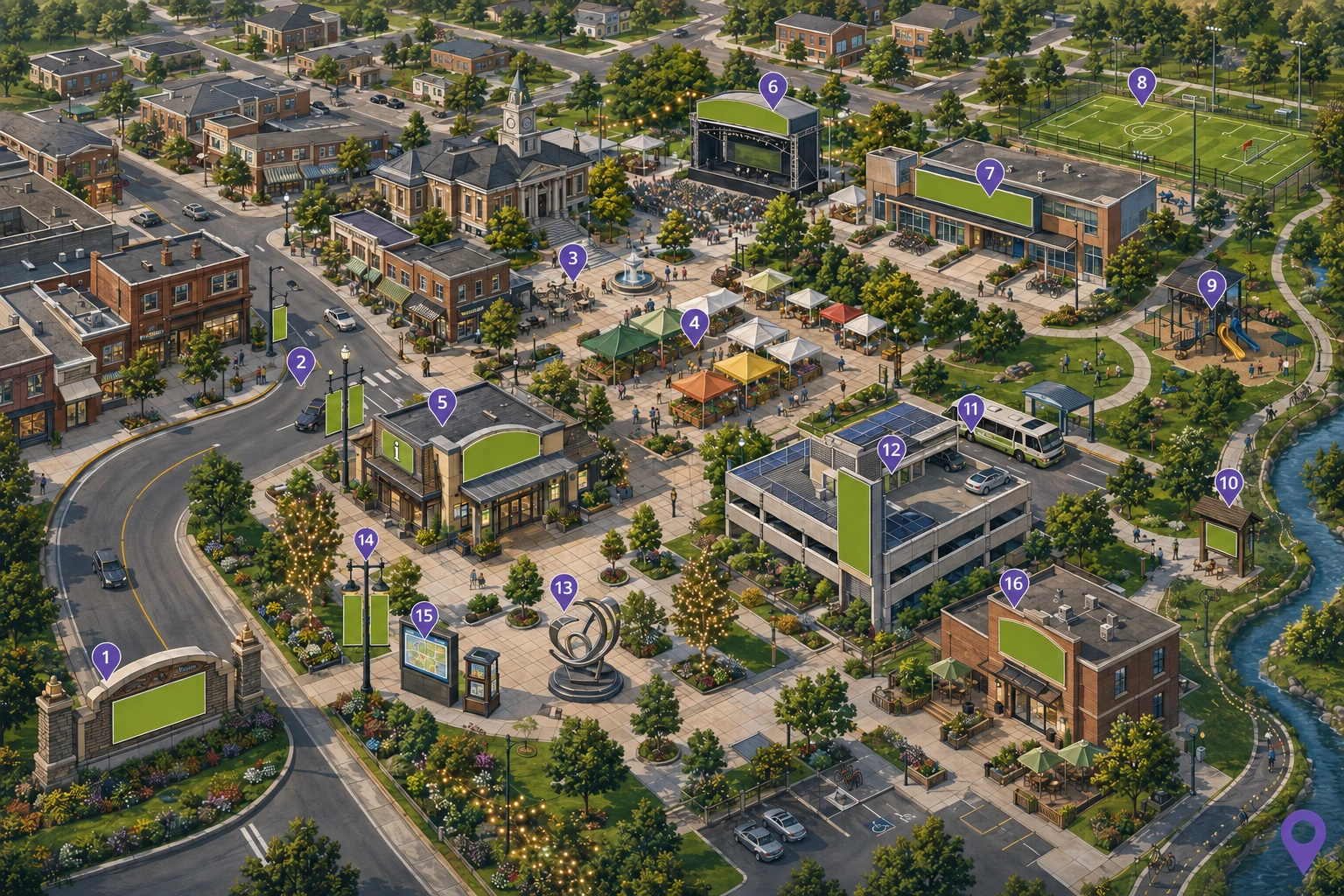
| Map | Asset class | Typical opportunity | Primary audience | Common sponsor objectives |
|---|---|---|---|---|
| 1 | Community Gateway | Entrance monument sponsorship | Visitors and residents | Community awareness and arrival branding |
| 2 | Downtown & Streetscape | Street banner program | Residents, commuters, and downtown visitors | Local visibility and district branding |
| 3 | Public Spaces | Plaza sponsorship or seasonal programming | Families, residents, and visitors | Community engagement and placemaking |
| 4 | Events & Programs | Farmers market sponsorship | Families and local shoppers | Brand activation and local business awareness |
| 5 | Tourism & Visitor Services | Visitor center partnership | Tourists and regional visitors | Visitor acquisition and destination awareness |
| 6 | Events & Programs | Concert or festival presenting sponsorship | Community-wide audience | High-profile awareness and engagement |
| 7 | Recreation | Recreation center or wellness program sponsorship | Families, youth, adults, and older residents | Wellness positioning and family visibility |
| 8 | Recreation | Sports field, league, or youth program sponsorship | Youth athletes, parents, and spectators | Long-term community presence and repeat exposure |
| 9 | Public Spaces | Playground or family area sponsorship | Families and caregivers | Family-focused branding and community support |
| 10 | Public Spaces | Trail, greenway, or outdoor program sponsorship | Residents, visitors, and outdoor recreation users | Health, recreation, and sustainability alignment |
| 11 | Downtown & Streetscape | Transit stop, shuttle, or commuter amenity sponsorship | Commuters, residents, and visitors | Frequent daily exposure and transportation access |
| 12 | Downtown & Streetscape | Parking facility or downtown arrival sponsorship | Downtown visitors, workers, and shoppers | Arrival visibility and convenience branding |
| 13 | Public Spaces | Public art or placemaking initiative | Residents and visitors | Community investment and cultural association |
| 14 | Community Partnerships | Seasonal lighting or beautification program | Residents, visitors, and local businesses | Civic pride and corporate social responsibility |
| 15 | Tourism & Visitor Services | Visitor guide, community map, or digital kiosk | Visitors and prospective visitors | Destination marketing and trip planning |
| 16 | Economic Development | Business development or entrepreneurship program | Business owners, entrepreneurs, employers, and investors | Economic leadership and business-to-business visibility |
Record assets before deciding what to sell
An inventory is not a commitment to commercialize every asset. Its purpose is to document what exists, who controls it, which audiences encounter it, and whether a partnership could improve or weaken the community experience.
Each inventory record should identify the responsible department, location, season, audience, current sponsor, existing restrictions, production requirements, digital extensions, approval process, and renewal date. This information creates the foundation for evaluating opportunities consistently in the next stage.
Evaluating different types of community opportunities
Once a community has documented its sponsorship inventory, the next challenge is deciding which opportunities deserve the greatest attention. Not every asset creates value in the same way, and the largest or most visible opportunity is not always the strongest one.
A downtown banner is primarily a physical advertising placement. A farmers market partnership is a broader sponsorship program. Naming rights for a recreation center create a longer-term association with a public facility. Each may be valuable, but they should not be evaluated using exactly the same criteria.
The SiiqIQ Opportunity Rating uses a directional model based on the type of opportunity being reviewed. Each factor is scored from one to five, and the weighted result is converted to a 100-point scale.
Model 1
Physical placements
Used for individual advertising surfaces or media placements such as street banners, entrance signs, transit panels, visitor-center displays, digital kiosks, and other locations where visibility is the primary product.
- Dwell
- 30%
- Visibility
- 25%
- Repeat exposure
- 20%
- Audience mindset
- 15%
- Interaction
- 10%
Model 2
Sponsorship programs
Used for events, recreation programs, leagues, markets, beautification initiatives, visitor partnerships, and other opportunities that combine recognition with participation, engagement, or community support.
- Audience alignment
- 25%
- Visibility
- 20%
- Engagement
- 20%
- Repeat exposure
- 20%
- Community alignment
- 15%
Model 3
Naming rights
Used for longer-term associations with recreation centers, pavilions, plazas, sports complexes, visitor facilities, and other prominent community assets whose names may appear across physical and digital communications.
- Prominence
- 20%
- Duration
- 15%
- Exclusivity
- 20%
- Institutional association
- 15%
- Communications usage
- 15%
- Audience relevance
- 15%
Choose the model based on what is being offered
The same community asset can support more than one type of opportunity. What matters is the specific product being evaluated.
| Community asset | Opportunity being evaluated | Rating model |
|---|---|---|
| Recreation center | Lobby digital display | Physical placement |
| Recreation center | Community wellness program sponsor | Sponsorship program |
| Recreation center | Facility naming rights | Naming rights |
| Downtown district | Street banner placement | Physical placement |
| Downtown district | Year-round downtown partnership | Sponsorship program |
| Community festival | Stage-backdrop advertisement | Physical placement |
| Community festival | Festival presenting sponsor | Sponsorship program |
Use the ratings to prioritize development
Opportunity Ratings are most useful for comparing opportunities within the same model. A physical-placement rating can help compare street banners, entrance signs, transit panels, and digital displays. A sponsorship-program rating can help compare festivals, recreation programs, markets, and community initiatives.
Ratings from different models may all use a 100-point scale, but they do not represent identical products. A score of 85 for a physical placement and a score of 85 for a sponsorship program indicate that each has strong characteristics within its own category. They do not mean that the opportunities should receive the same price.
| Score | Classification | Suggested use |
|---|---|---|
| 90 to 100 | Exceptional | Flagship opportunities that may justify premium positioning, carefully defined exclusivity, or prominent package placement. |
| 75 to 89 | Strong | High-priority opportunities suitable for individual sale or inclusion in major partnership packages. |
| 60 to 74 | Moderate | Useful opportunities that may become stronger when improved or bundled with higher-rated assets. |
| 40 to 59 | Limited | Secondary opportunities that may require better visibility, stronger benefits, clearer audience definition, or additional promotion. |
| Below 40 | Low priority | Opportunities that may not justify active sales effort unless they support a larger package or important community objective. |
Packaging opportunities around sponsor objectives
Individual assets may be sold separately, but the strongest sponsorship programs are usually built around experiences, audiences, or community outcomes rather than isolated signs and logo placements.
A sponsor may not be especially interested in purchasing one street banner, one event logo, or one website placement. The same sponsor may be interested in becoming a visible supporter of downtown activity, family recreation, visitor services, entrepreneurship, or a year-round calendar of community events.
This shift from selling assets to building experiences makes the package easier to understand and gives each included asset a defined role. One element may create visibility, another may provide engagement, and another may create measurable digital interaction.
Begin with the sponsor's objective
Before selecting assets, define what the partnership is intended to accomplish. Common objectives include:
- Community awareness: Increase recognition among residents, visitors, commuters, or downtown audiences.
- Audience engagement: Create direct interaction through events, demonstrations, contests, educational activities, or useful services.
- Business development: Reach business owners, employers, investors, entrepreneurs, or other organizational decision makers.
- Visitor acquisition: Influence trip planning, destination awareness, spending, and movement within the community.
- Family and youth reach: Build recognition through recreation, camps, sports, playgrounds, and family-oriented events.
- Corporate social responsibility: Demonstrate support for beautification, sustainability, volunteerism, public programming, or community improvement.
Think in experiences instead of individual assets
Downtown Partnership
Designed for businesses seeking a visible, recurring association with the downtown district and its economic activity.
- Street banner recognition
- Public plaza or gathering space presence
- Downtown website placement
- Business directory recognition
- Seasonal event participation
Visitor Experience
Designed for businesses that benefit from tourism, regional visitation, hospitality, and destination awareness.
- Visitor guide placement
- Welcome center recognition
- Destination map presence
- Tourism newsletter inclusion
- Visitor information kiosk placement
Family Recreation
Designed for sponsors seeking recurring visibility among families, youth participants, caregivers, and recreation users.
- Sports field or league recognition
- Recreation center presence
- Summer camp support
- Playground or family area sponsorship
- Wellness programming
Annual Events
Designed for sponsors seeking broad awareness across several seasonal community experiences.
- Concert series sponsorship
- Festival recognition
- Holiday lighting partnership
- Farmers market presence
- Digital event calendar promotion
Economic Development
Designed for companies seeking business-to-business visibility, workforce recognition, or association with local economic growth.
- Business workshop support
- Entrepreneurship program recognition
- Business award sponsorship
- Networking event participation
- Relocation or investment guide placement
Community Impact
Designed for organizations seeking a credible association with visible community improvements and public benefit.
- Beautification initiative support
- Volunteer program participation
- Sustainability project recognition
- Public art partnership
- Community improvement reporting
Give every asset a defined role
A package should not become a collection of unrelated inventory added only to make the offering appear larger. Each element should support the central objective of the partnership.
| Asset role | Purpose | Examples |
|---|---|---|
| Flagship visibility | Establishes the sponsor as a recognizable supporter of the overall experience or initiative. | Presenting sponsor, entrance recognition, stage backdrop, naming opportunity, or primary program identity. |
| Repeated exposure | Reinforces the sponsor relationship across time or several audience touchpoints. | Banners, newsletters, websites, guides, wayfinding, and recurring program communications. |
| Engagement | Gives the sponsor a way to interact with participants or provide something useful. | Booths, demonstrations, sampling, contests, workshops, and volunteer activities. |
| Digital action | Provides a measurable path from sponsorship exposure to additional information or participation. | Dedicated landing pages, QR codes, email links, offer codes, event registrations, and digital maps. |
| Community benefit | Clearly explains how the partnership supports the place, program, or audience. | Free programming, facility improvements, scholarships, maintenance, equipment, accessibility, and beautification. |
Document exactly what the sponsor receives
Each package should clearly identify the agreement term, asset locations, recognition level, digital placements, event rights, production responsibilities, creative deadlines, category restrictions, reporting, renewal process, and any benefits that depend on attendance or program delivery.
Communities should also distinguish guaranteed deliverables from estimated exposure. A logo placement, number of newsletters, event booth, or installation period can usually be guaranteed. Attendance, impressions, media coverage, and visitor activity may need to be presented as estimates unless they are measured through a reliable process.
Advertising compared with sponsorship
Communities often use the words advertising and sponsorship interchangeably, but they describe different relationships. Understanding the distinction helps organizations structure packages, policies, agreements, recognition, and pricing more clearly.
Advertising primarily involves purchasing access to an audience through a defined media placement. Sponsorship is a broader association with a place, event, program, or community objective. A sponsorship may include advertising benefits, but its value often extends beyond the placement itself.
| Consideration | Advertising | Sponsorship |
|---|---|---|
| Primary purpose | Purchase visibility, reach, traffic, or a specific media placement. | Build an association with a place, event, program, audience, or community outcome. |
| Typical deliverables | Signage, banner space, website placement, display advertising, newsletter placement, or printed media. | Recognition, presenting rights, event participation, hospitality, activation, digital promotion, category rights, and community impact. |
| Message control | The advertiser typically provides a promotional message within established creative standards. | Recognition may be more restrained and integrated into the identity of the supported program or experience. |
| Value basis | Audience size, placement prominence, frequency, format, and measurable delivery. | Audience value plus association, exclusivity, activation rights, hospitality, community alignment, and partnership benefits. |
| Typical term | Campaign, issue, placement period, event, season, or annual media schedule. | Event, program, season, annual partnership, or multi-year relationship. |
| Public perception | Usually understood as a commercial message. | Often understood as support for a program, place, event, or public purpose. |
A sponsorship can contain advertising benefits
The two models are not mutually exclusive. A downtown festival sponsor may receive acknowledgement as the presenting partner while also receiving banners, website placement, social media recognition, and an event booth. The broader relationship is a sponsorship, while several included benefits function as advertising or promotional media.
This distinction is useful when preparing agreements. The organization can identify the overall partnership purpose, then list the specific advertising, recognition, activation, hospitality, and reporting benefits included.
Recognition should fit the public setting
Public spaces and community programs require greater sensitivity than many commercial media environments. Sponsor recognition should be visible enough to provide value, but restrained enough to protect the character, safety, accessibility, and purpose of the place.
A sponsor may be prominently acknowledged on an event page or stage backdrop while receiving more limited recognition near a playground, public memorial, historic district, or civic building. The appropriate balance depends on the asset, audience, public purpose, and applicable policies.
Review legal, tax, and policy considerations
The legal and tax treatment of advertising, sponsorship, donations, naming rights, and commercial use of public property can vary by organization and jurisdiction. Municipal procurement rules, sign ordinances, public records laws, naming policies, alcohol restrictions, nonprofit tax rules, existing concession agreements, and content limitations may all affect what can be offered.
Valuing and pricing sponsorship opportunities
There is no universal rate card for community sponsorships. Two programs with similar attendance may have very different value because of audience relevance, visibility, exclusivity, duration, activation rights, public importance, or included digital promotion.
For that reason, communities should begin by estimating the value of the opportunity rather than immediately selecting a price. Valuation asks what makes the partnership useful to a sponsor. Pricing asks what the market is willing to pay for that value.
Physical visibility
Consider where the sponsor appears, how noticeable the recognition is, and whether the audience naturally encounters it. A community entrance, festival stage, or downtown banner may provide strong visibility. A hidden trail segment, secondary hallway, or crowded bulletin board may provide less.
Audience reach and relevance
Estimate the number and type of people likely to encounter the opportunity. Residents, families, visitors, business owners, commuters, and recreation users have different value to different sponsors. A smaller but more relevant audience can justify a stronger price than a larger audience with little connection to the sponsor's market.
Program importance
Some assets are central to the community experience. A signature festival, recreation program, visitor center, downtown initiative, or entrepreneurship program may carry more value because residents and businesses recognize its importance.
Program importance is not simply another name for attendance. It also reflects reputation, longevity, public benefit, civic identity, and the difficulty of replacing or replicating the opportunity.
Duration and frequency
Define whether the partnership lasts for a weekend, season, full year, or multi-year term. Consider both the length of the agreement and the frequency of audience encounters during that period.
A weekend event can create concentrated awareness. A seasonal banner, visitor guide, recreation league, newsletter, or digital program may create lower daily exposure but more repetition over time.
Exclusivity
Category exclusivity can increase sponsorship value because the organization agrees not to offer similar rights to a direct competitor. Presenting rights, exclusive naming, preferred-provider recognition, and sole category status should therefore be priced more carefully than shared recognition.
Exclusivity should be defined narrowly. The agreement should identify the exact category, term, applicable assets, geographic limits, and exceptions. Broad restrictions can prevent the organization from working with unrelated businesses or existing vendors.
Activation rights
Activation gives the sponsor a way to participate rather than simply display its name. Depending on the setting, rights may include sampling, a booth, demonstrations, contests, educational programming, volunteer participation, speaking opportunities, hospitality, lead collection, or product displays.
These rights can substantially increase value when they create useful interactions and remain consistent with the community experience.
Digital promotion
Digital benefits can extend the life and measurability of a physical sponsorship. Website recognition, newsletters, social media, event pages, community maps, visitor guides, mobile applications, and registration communications may all reinforce the sponsor relationship.
Digital placements should be documented individually. Specify the number of emails, expected placement period, page location, link destination, post frequency, and any reporting the organization can reliably provide.
Production and fulfillment costs
Printing, installation, maintenance, creative changes, event staffing, security, permits, electricity, insurance, hospitality, equipment, and administrative time can all affect the economics of a sponsorship.
Communities should determine which costs are included in the sponsorship fee, charged separately, paid directly by the sponsor, or handled by an approved vendor. A package should not be considered profitable until the full cost of delivery has been considered.
Comparable opportunities and sponsor demand
Internal valuation should be compared with other opportunities available to the same businesses. These may include local event sponsorships, sports programs, nonprofit partnerships, chamber packages, media placements, outdoor advertising, digital campaigns, or neighboring community programs.
Comparable pricing provides context, but it should not be copied without considering differences in audience, benefits, exclusivity, quality, and community importance.
Sponsor demand provides the strongest pricing signal. If several appropriate businesses compete for one opportunity, the organization may have room to increase pricing or introduce limited exclusivity. If qualified prospects consistently decline, the price, package, audience definition, or sales process may need to be revised.
Establish a pricing range rather than one unexplained number
A useful internal pricing record should document:
- Estimated audience and exposure assumptions
- Opportunity Rating and supporting observations
- Comparable local sponsorships or media options
- Production and fulfillment costs
- Value of included digital and activation rights
- Exclusivity or category restrictions
- Standard rate, pilot rate, and approved discount authority
- Minimum acceptable value for negotiation
This creates consistency without pretending that every sponsorship can be priced through a universal formula.
Connect pricing to reporting expectations
Sponsors increasingly expect evidence showing what was delivered. Before setting a price, communities should determine what they can reasonably report.
- Attendance or participation
- Estimated physical impressions
- Website traffic or digital delivery
- QR scans, registrations, or offer activity
- Photographs of installed recognition
- Social media delivery
- Media coverage
- Community or economic outcomes
Strong reporting does not require claiming that every sponsorship produced a direct sale. It requires documenting the agreed benefits, audience activity, participation, and community value honestly enough to support a useful renewal conversation.
Community sponsorship program implementation checklist
A community does not need to launch a large sponsorship program all at once. A better approach is to establish a repeatable process, begin with a manageable group of opportunities, and improve the program as the organization gains experience.
The following sequence moves from internal preparation to public launch, measurement, and renewal.
Inventory community assets
Document public spaces, events, programs, recreation assets, visitor services, digital channels, and community initiatives that may support an appropriate partnership.
Classify and evaluate every opportunity
Determine whether each opportunity is a physical placement, sponsorship program, or naming-rights offering. Apply the appropriate rating model, then review operational requirements, policy limitations, and public suitability.
Create sponsorship packages
Combine compatible assets around a sponsor objective, audience, experience, or community outcome. Keep each package focused and easy to understand.
Develop sponsorship policies
Define eligible sponsors, prohibited categories, approval authority, design standards, naming restrictions, procurement requirements, content rules, and termination rights.
Establish pricing guidelines
Document value assumptions, comparable opportunities, production costs, standard rates, pilot rates, discount authority, and minimum acceptable value.
Publish available opportunities
Make the program easy to discover. Provide clear package descriptions, audience information, timing, pricing guidance, policies, and a consistent inquiry process.
Measure sponsor delivery and impact
Track agreed deliverables, attendance, digital activity, photographs, media coverage, sponsor participation, and relevant community outcomes.
Improve and renew annually
Review package performance, sponsor feedback, community response, operational costs, pricing, demand, and renewal potential before the next program cycle.
Start with a limited pilot
A pilot program can help the organization test its policies, pricing, agreements, fulfillment process, and reporting without committing every available asset. Select several opportunities that are visible, manageable, appropriate for the setting, and likely to attract qualified sponsors.
A useful pilot might include one community event, one recurring program, one digital channel, and one physical asset. This provides enough variety to evaluate different sponsorship models while keeping the first launch practical.
Assign clear internal ownership
Every program needs a defined person or team responsible for maintaining the inventory, coordinating approvals, communicating with sponsors, documenting agreements, confirming delivery, and initiating renewals.
Ownership does not require one department to control every asset. It does require a central record showing who is responsible for each opportunity and how decisions are made.
Create standard documents
Standardized materials reduce administrative work and improve consistency. A basic sponsorship program should prepare:
- A community sponsorship policy
- An asset inventory
- A package or opportunity summary
- A pricing and approval worksheet
- A sponsorship agreement template
- Creative and brand standards
- A delivery checklist
- An annual sponsor report template
- A renewal schedule
Measuring results and supporting sponsor renewals
Sponsorship measurement is often treated as an afterthought. A sponsor pays for a package, receives the agreed recognition, and may hear little from the organization until renewal time.
That approach makes it difficult for the sponsor to understand what was delivered or justify another investment. It also prevents the community from learning which assets, packages, and partnership models create the strongest results.
Measurement should begin before the agreement is signed. The organization and sponsor should identify the objectives of the partnership, the deliverables that will be documented, the data that can reasonably be collected, and the limitations of that data.
Separate delivery reporting from outcome reporting
Delivery reporting confirms that the organization provided what it promised. Outcome reporting evaluates what happened as a result.
| Reporting type | What it answers | Examples |
|---|---|---|
| Delivery reporting | Did the organization provide the agreed sponsorship benefits? | Installation dates, event participation, website placement, newsletter delivery, photographs, social posts, signage, and activation rights. |
| Audience reporting | How many people may have encountered the opportunity? | Attendance, registrations, facility use, visitor counts, website traffic, email circulation, social reach, and modeled impressions. |
| Engagement reporting | Did the audience take an observable action? | QR scans, website visits, offer redemptions, contest entries, registrations, booth interactions, downloads, and inquiries. |
| Community outcome reporting | What public or program benefit did the sponsorship help support? | Free programming, scholarships, equipment, beautification, volunteer hours, increased access, facility improvements, and supported participants. |
| Sponsor outcome reporting | Did the partnership support the sponsor's business or reputation objectives? | Sponsor feedback, brand awareness research, leads, sales data, employee participation, customer response, and renewal interest. |
Avoid presenting estimates as verified results
Many community organizations will not have access to audited impression measurement. Attendance, pedestrian activity, facility use, website traffic, and publication circulation can still provide useful planning information, but the methodology and assumptions should be clearly stated.
For example, an estimated audience based on event attendance should not be described as a verified number of people who noticed a sponsor logo. A newsletter distribution count does not guarantee that every recipient opened the message. A website page view does not prove sponsor recall.
Transparent estimates are more credible than precise claims that the organization cannot support.
Build an annual sponsor report
An annual sponsor report can combine delivery evidence, audience activity, community outcomes, and recommendations for the next cycle.
Schedule renewal conversations early
Renewal should not begin after a sponsorship has expired. Contact sponsors far enough in advance to review results, discuss changes, reserve high-demand opportunities, and complete approvals before the next program cycle.
For annual agreements, renewal planning may begin 90 to 180 days before the end of the term. Major events, public installations, and packages requiring procurement or legal review may require even more time.
Use renewals as a pricing signal
Renewal behavior provides useful information about market value. Strong renewal demand may indicate that an opportunity is underpriced or that additional benefits could support a higher tier. Consistent sponsor hesitation may indicate that the package is unclear, difficult to activate, poorly measured, or priced above perceived value.
Free planning workbook
Build your Community Sponsorship Program
Download the editable Excel workbook to inventory community assets, calculate directional Opportunity Ratings, build sponsorship packages, organize the annual calendar, track sponsor relationships, document reporting, and review policy requirements.
What the Community Sponsorship Program Workbook includes
The workbook is designed to support the complete program lifecycle rather than function only as an asset list.
Community Asset Inventory
Record each asset, responsible department, audience, season, current sponsor, restrictions, production requirements, and availability.
Opportunity Rating
Classify each opportunity as a physical placement, sponsorship program, or naming-rights offering. Score it using the corresponding factors and calculate a directional rating on a 100-point scale.
Package Builder
Combine compatible assets around an audience, sponsor objective, experience, or community outcome.
Annual Calendar
Track seasonal programs, events, installation periods, sales deadlines, creative deadlines, contract terms, and renewals.
Sponsor CRM
Organize prospects, industries, contacts, interested assets, conversations, next steps, agreement status, and renewal timing.
ROI and Delivery Reporting
Record attendance, estimated impressions, digital activity, photographs, media mentions, sponsor feedback, and renewal status.
Policy Checklist
Review sponsor restrictions, approval authority, legal review, brand standards, insurance, sign requirements, procurement, and records.
Example package builder
Example
Downtown Partnership Package
- Street banner program
- Visitor guide recognition
- Farmers market sponsorship
- Downtown website placement
- Seasonal event sponsorship
The package builder should also record the sponsor objective, term, exclusivity, production responsibilities, digital benefits, activation rights, estimated audience, reporting commitments, internal cost, standard price, negotiated price, and approval status.
Common mistakes to avoid
Organizing opportunities only by department
Departments need clear internal ownership, but the public-facing inventory should also reflect how sponsors think about audiences, experiences, and community outcomes. A purely departmental structure can hide opportunities that belong together.
Attempting to commercialize every asset
An inventory identifies potential opportunities. It does not mean that every park, building, program, sign, or communication channel should carry a sponsor. Communities should preserve unsponsored places and limit recognition where commercial activity would weaken the public experience.
Using inconsistent pricing without documentation
Informal pricing can create confusion when sponsors compare agreements or seek renewals. Use a consistent valuation process, record approved discounts, and distinguish between standard, pilot, nonprofit, and in-kind arrangements.
Offering broad exclusivity
Poorly defined category exclusivity can prevent the community from working with existing vendors, adjacent industries, or future partners. Define the exact category, assets, term, territory, and exceptions.
Failing to calculate fulfillment costs
Printing, installation, staff time, event support, maintenance, insurance, security, creative changes, and reporting can reduce the financial value of a package. Estimate those costs before establishing pricing.
Promising results the organization cannot measure
Attendance and delivery can often be documented. Brand awareness, sales, visitor spending, and direct return on investment may be more difficult. Clearly distinguish observed results from estimates and sponsor-provided information.
Waiting until the end of the agreement to discuss renewal
Late renewal conversations create unnecessary urgency and increase the risk that the sponsor has already committed its budget elsewhere. Establish renewal dates and begin reporting before the agreement ends.
Frequently asked questions
What types of community assets can be sponsored?
Potential assets include public events, recreation programs, sports facilities, visitor guides, welcome centers, street banner programs, downtown maps, newsletters, websites, business workshops, beautification projects, sustainability initiatives, public art, trails, plazas, and selected naming or presenting opportunities. Availability depends on ownership, existing contracts, public policy, local law, and the appropriateness of commercial recognition within the setting.
Should sponsorship opportunities be managed by one department?
One team should maintain the central inventory and coordinate policies, active sponsors, category restrictions, reporting, and renewals. Individual departments may still control approvals and delivery for the assets they manage.
How should a community price a sponsorship?
Begin by identifying whether the offering is a physical placement, sponsorship program, or naming-rights opportunity. Evaluate it using the appropriate factors, then consider audience size and relevance, duration, exclusivity, activation rights, digital promotion, fulfillment costs, comparable opportunities, and actual sponsor demand.
What is the difference between advertising and sponsorship?
Advertising generally involves purchasing a defined media placement or promotional message. Sponsorship creates a broader association with a place, program, event, audience, or community objective. Sponsorship packages may contain advertising benefits.
Can a municipality or public agency accept sponsorships?
Many public organizations use sponsorships, but authority and approval requirements vary. Organizations should review procurement rules, naming policies, sign regulations, ethics requirements, public records laws, existing contracts, content restrictions, and any required legal or governing-body approvals.
Should sponsors receive category exclusivity?
Exclusivity can increase value, but it should be narrowly defined. Specify the exact category, term, assets, territory, and exceptions. Avoid broad language that prevents the organization from working with unrelated companies or existing vendors.
How can a small organization manage sponsorships without a sales team?
Begin with a limited inventory, several clearly documented packages, a standard inquiry process, reusable agreements, a central tracking worksheet, and scheduled renewal reminders. Existing vendors, members, local employers, nearby businesses, and previous event supporters can provide an initial prospect pool.
What should be included in a sponsorship agreement?
The agreement should identify the exact assets, term, price, payment schedule, production responsibilities, creative deadlines, approval process, category rights, insurance requirements, reporting, renewal terms, cancellation rights, interruption provisions, and removal responsibilities.
How should in-kind sponsorships be valued?
Document the fair value of the goods or services provided, confirm that the contribution replaces an actual organizational expense, and compare that value with the benefits granted to the sponsor. Avoid assigning inflated values that cannot be supported.
What happens when an event is cancelled or a program is interrupted?
Agreements should include a make-good or interruption provision. Alternatives may include an extended term, replacement event, substitute placement, additional digital exposure, a credit, or another mutually agreed benefit.
Turn existing community assets into structured partnerships
Municipalities, business districts, tourism organizations, parks departments, chambers, and economic development organizations often manage far more sponsorship value than they recognize. The opportunity is spread across public places, programs, events, recreation systems, visitor services, digital communications, and community initiatives.
Building a sustainable program does not require creating commercial inventory everywhere. It requires documenting appropriate assets, evaluating them consistently, grouping them into coherent packages, establishing policies, pricing them transparently, and delivering what was promised.
Start by connecting the sponsorships that already exist. Create one shared inventory, identify the strongest opportunities, test several focused packages, and document sponsor delivery. The feedback from those early partnerships can guide future pricing, policies, reporting, and expansion.
Have community sponsorship opportunities to offer?
SIIQ helps municipalities, districts, tourism organizations, and other community-serving organizations make sponsorship and advertising opportunities easier for businesses to discover.
Sources and methodology
External research
This guide draws on research and guidance concerning public-private partnerships, destination stewardship, downtown management, community development, sponsorship strategy, and organizational sustainability. Claims based on external research should be linked to the original publisher whenever available and reviewed when the guide is materially updated.
- AlMujadidi, Loay, Christian Azoury, Dirk Schmautzer, and Jonathan Woetzel. McKinsey & Company. Unlocking the Full Potential of City Revenues . July 12, 2019. PDF . Accessed July 2026. ↩
- United Nations Development Programme. Partners in Development: How Donors Can Better Engage the Private Sector for Development in LDCs . Accessed July 2026.
- Main Street America. Federal Funding Sources for Main Streets . July 22, 2024. Accessed July 2026.
- Destinations International. The Definition of Destination Stewardship . October 16, 2024. Accessed July 2026.
- Additional municipal policies, sponsorship programs, procurement guidance, tax resources, and original industry research used to support published factual claims.
SIIQ-created analysis
The Community Opportunity Map, sponsorship portfolio categories, inventory framework, Community Sponsorship Maturity Model, SiiqIQ opportunity-rating models, package framework, valuation framework, implementation roadmap, reporting framework, and workbook structure were developed by SIIQ for educational and planning purposes.
The SiiqIQ physical-placement, sponsorship-program, and naming-rights ratings are directional assessments of opportunity characteristics. They are not based on observed campaign performance and do not guarantee impressions, engagement, sponsor demand, pricing, revenue, or renewal.
Audience, attendance, exposure, economic impact, and engagement estimates should be treated as illustrative unless supported by an identified measurement process or external source.
Sponsorship valuation is not the same as market price. Communities should test pricing against comparable opportunities, local sponsor demand, fulfillment costs, negotiation, and renewal behavior.
Organizations should replace generalized assumptions with local asset data, attendance, visitor activity, program participation, digital analytics, production costs, policies, contracts, and sponsor feedback.
Last reviewed: July 2026

The Local Business Advertising Revenue Field Guide
Inventory assets, build sponsorship packages, calculate opportunity ratings, track advertisers, and develop pricing worksheets.
Read guide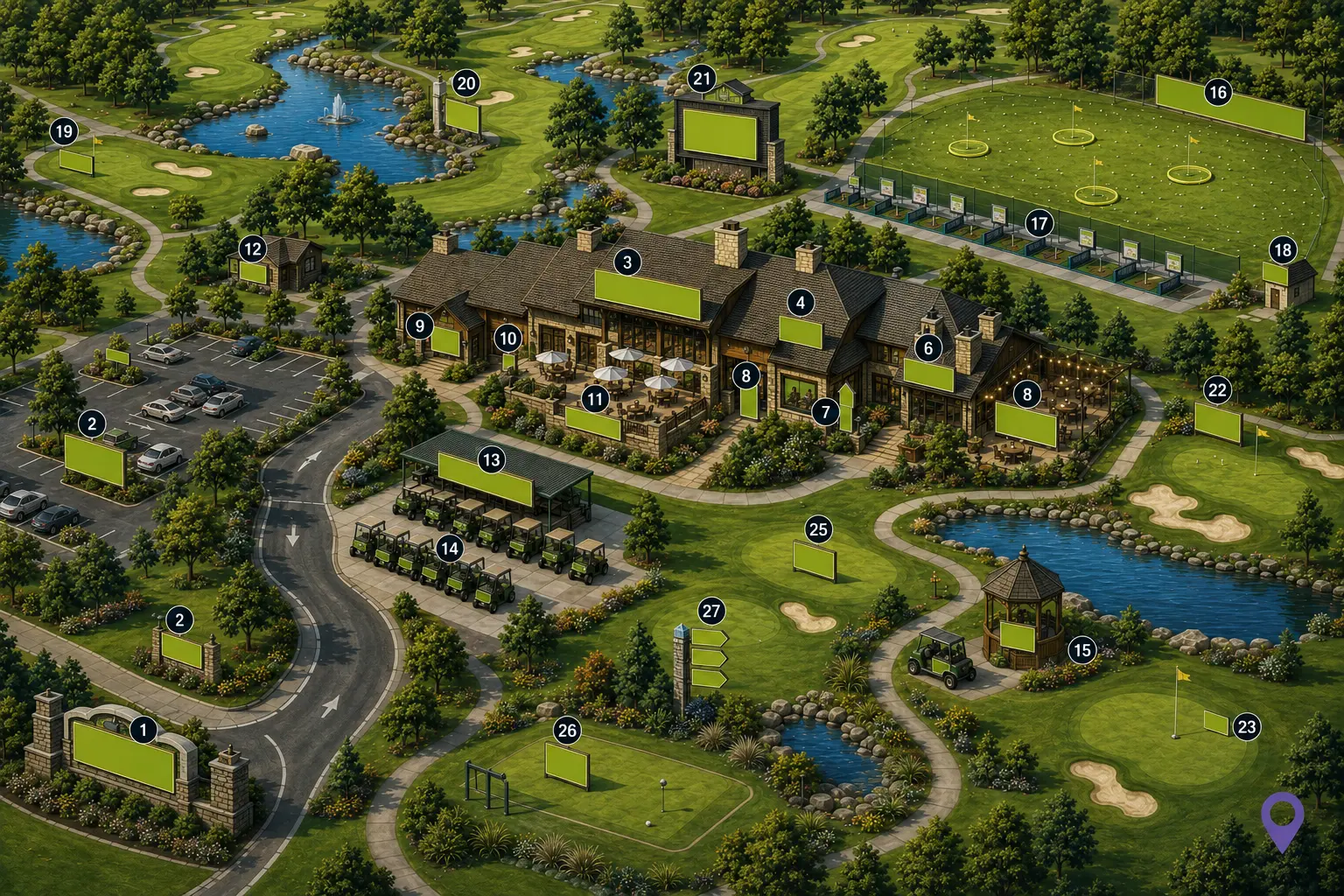
How Golf Courses Can Generate Advertising Revenue
A practical guide to identifying, evaluating, packaging, and pricing advertising and sponsorship opportunities across a golf course.
Read guide