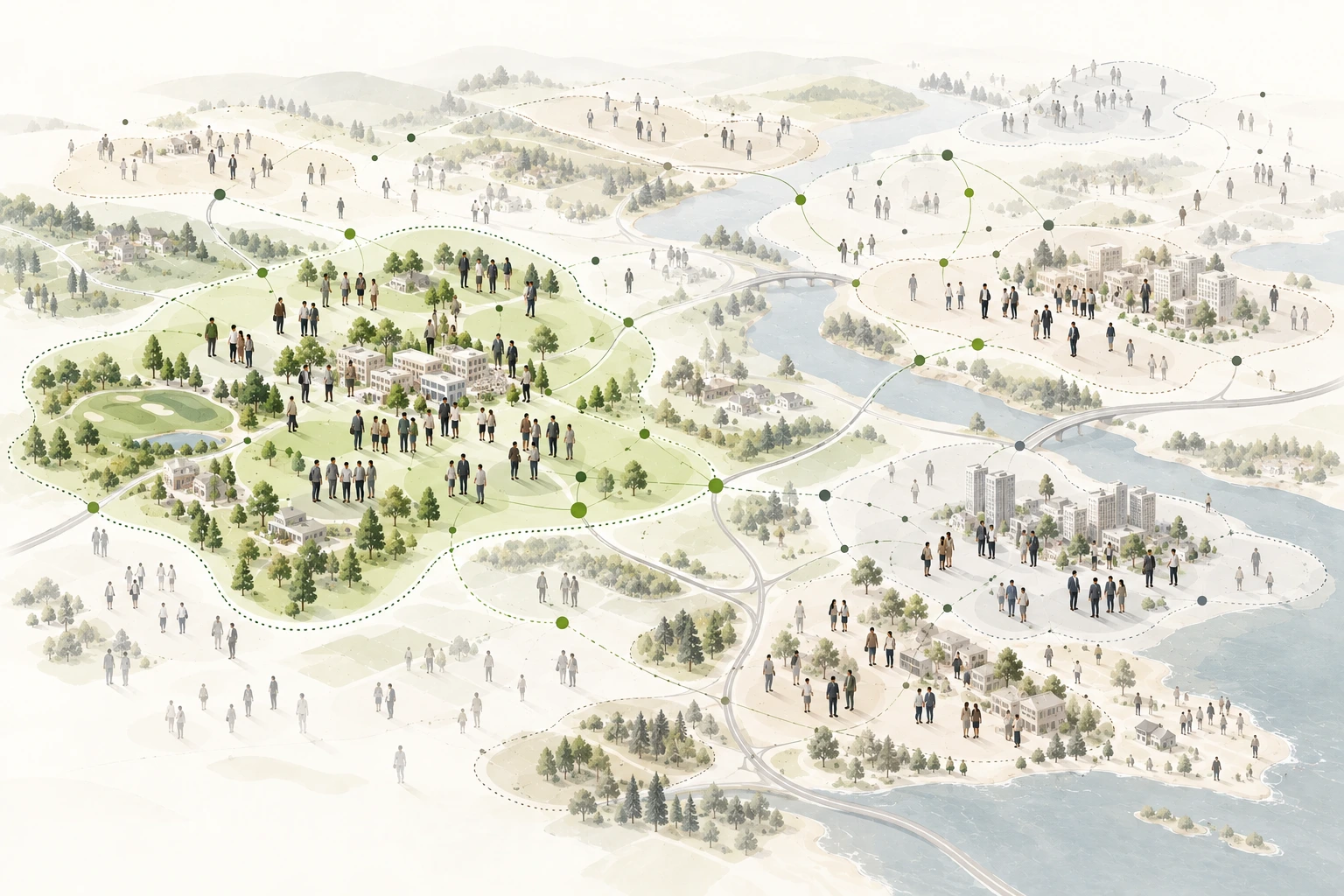
A golf course may discover that many of its long-tenured, high-revenue members are homeowners between 45 and 64 with relatively high household incomes. With readily available demographic data, it isn’t difficult to find nearby ZIP codes containing similar populations.
That may be useful. It doesn’t necessarily tell the course where its next valuable customers will come from.
People who look alike in demographic data do not necessarily behave alike as customers. Two communities can have nearly identical age, income and homeownership profiles while producing dramatically different results for the same business. Distance may explain some of the difference, but so might competition, commuting patterns, accessibility, historical marketing, customer referrals or simple familiarity with the business. One community may sit fifteen miles away along a direct highway while another sits twelve miles away across congested local roads. A competitor may have a strong presence in one market while another contains a network of existing customers who have spent years introducing friends and colleagues to the business.
Demographics describe part of a market. They don’t explain the customer relationship.
A more useful place to begin is with the relationships that have already formed.
The market you reach isn’t necessarily the market you could reach
If the course maps the origins of its customers, the pattern may look very different from a circle drawn around the property. Several nearby communities may account for a disproportionate share of long-tenured members. Another may produce relatively few customers despite being close to the course. A town farther away may unexpectedly generate more frequent golfers than communities half the distance.
Not every customer belongs neatly inside a local market. Some golfers travel for tournaments or special events. Others maintain memberships despite moving farther away. Destination golfers may come from well outside the area from which the course normally attracts recurring customers. Those exceptions are part of the audience too, but the broader pattern begins revealing something that distance alone cannot.
A trade area is not simply the area around a business. It is the geography from which customer relationships actually emerge.
That geography describes the market the business has actually reached. It does not necessarily describe the entire market it could serve.
A community with very few customers may still be a realistic market if access is convenient, the business serves comparable communities nearby and there is reason to believe low awareness or limited historical marketing has constrained customer acquisition. Conversely, a handful of customers may travel from well outside the area in which the business could reasonably expect to compete at scale.
Existing customers therefore reveal the shape of the business’s observed market. They provide evidence for understanding the broader potential market; they do not define its outer limits by themselves.
For a neighborhood restaurant, the pattern may be concentrated in a handful of nearby ZIP codes. A destination golf course may draw from a much wider region. An event venue may have substantially different customer origins depending on the event. A downtown district may simultaneously serve residents, commuters, tourists and visitors from surrounding communities.
A fixed radius can be a useful starting assumption. Customer origins can show where relationships actually occur. Travel time, accessibility and the nature of the business help establish where additional relationships are realistically possible.
The shape of the market is something to discover.
A strong market depends on what you’re measuring
Once those patterns become visible, apparently strong markets can provide useful comparisons. But strong needs a definition just as best customer did.
The community producing the most customers may not produce the most long-tenured customers. The market generating the greatest revenue may differ from the one generating the most frequent visits. A destination market may contribute relatively few customers but unusually high spending per visit.
A strong market is therefore strong relative to something the business values.
Suppose the golf course is interested in long-tenured members and discovers that three communities are particularly well represented among them. It can begin investigating what those places have in common. Perhaps they contain more households resembling the course’s long-tenured members. Travel time may be particularly favorable. Residents may commute through the area. Social or professional networks may connect existing members. Historical marketing may simply have been stronger there.
These are hypotheses generated by an observed customer pattern.
External information can help investigate them. Population and household characteristics describe the surrounding market. Employment and occupation data provide professional context. Commuting patterns can reveal connections between communities. Business composition, tourism activity, transportation networks or other local characteristics may matter depending on the business.
The distinction between those sources is important. Customer records tell the business something about relationships it has actually established. External market data describes the places in which those relationships exist. Neither should quietly become a substitute for the other.
The same caution applies to customer counts.
Imagine that the course has 300 customers from one community and 100 from another. The first appears to be the stronger market until we learn that it contains six times as many people who could plausibly become customers.
Customer volume tells us how many relationships the business has established.
Customer penetration asks how large that customer base is relative to the market from which those relationships could reasonably have been drawn.
The denominator matters.
For some businesses, population may be a reasonable starting point. Others may care about households, relevant businesses, workers, visitors or some more specific population. For specialized products and services, a reliable measure of the true eligible market may not exist at all. In those cases, the limitations of the denominator are part of the analysis rather than something to conceal.
This can substantially change how a business sees its geography. A large community may generate many customers while still being relatively underdeveloped. A smaller community may produce fewer customers but represent unusually strong penetration.
The more interesting comparison is often not where the business has the most customers, but where it appears to perform unusually well or poorly relative to the opportunity reasonably available there.
Suppose two nearby communities have similar household characteristics, sufficient population and reasonable access to the course. One has produced a substantial concentration of long-tenured members while the other has produced very few.
Now there is something worth investigating.
A competitor may dominate the second market. Travel may be more difficult than it appears on a map. Residents may orient toward a different commercial center. The course may have little awareness there.
Or the difference may represent an opportunity the business has simply never pursued.
The data doesn’t tell us which explanation is correct. It tells us where to look.
This is an important boundary because maps are persuasive. A lightly penetrated ZIP code sitting beside several strong ones can look remarkably like an untapped market once it has been shaded on a map.
Low penetration, however, can reflect low awareness, competition, inconvenient access, an unsuitable product, historical differences in marketing or customer preferences the available data does not capture. A market can resemble an existing strong market across several measurable characteristics and still be a poor place to pursue growth.
The useful conclusion is therefore not that a ZIP code is a “high-potential market.” It is that the evidence provides a reason to investigate it.
If a community has low current penetration despite reasonable travel time, a sufficiently large relevant population and meaningful similarities to markets where the business has already developed valuable customer relationships, the case becomes more interesting. That combination produces a hypothesis that can be tested through a targeted campaign, local partnership, event, market-specific offer or even a simple effort to measure awareness.
The objective isn’t to predict customer acquisition perfectly before spending a dollar. It is to make the next experiment more informed.
Growth can come from markets or relationships
Geography is only one place where growth can hide.
A golf course might discover that corporate outings generate strong revenue and introduce hundreds of people to the property, yet very few of those participants ever return independently. Long-tenured members may frequently purchase instruction while newer members rarely do. Families may appear regularly at certain events but be poorly represented in other programs. A venue may repeatedly attract a professional audience to conferences without developing much relationship with that audience elsewhere.
These are not primarily geographic gaps. They are gaps in the relationship between an audience and the business.
That gives growth two related but different forms.
One is market opportunity: places or populations the business could realistically serve but where valuable customer relationships appear underdeveloped.
The other is relationship opportunity: audiences the business already reaches but with whom a valuable relationship might be expanded or deepened.
In either case, the gap identifies something worth investigating rather than an outcome waiting to happen. An event participant may have no interest in becoming a member. A newer customer may never develop the same purchasing pattern as someone who has remained for ten years. A lightly penetrated market may remain lightly penetrated for very good reasons.
Growth analysis becomes more useful when it moves beyond “find more people” and begins asking where valuable customer relationships might be developed, expanded or deepened.
This is also where the appeal of customer lookalike analysis needs some restraint. The basic logic is sensible: understand the characteristics associated with valuable customers, identify people or markets with similar characteristics and use those similarities to focus the search.
The danger comes when similarity becomes the conclusion.
A market can look similar demographically while differing substantially in competition, accessibility or awareness. A person can resemble a valuable customer across several characteristics without having any interest in the product. A community can contain many households fitting an audience profile while sitting outside a realistic service or travel area.
Similarity helps narrow the search. It doesn’t finish it.
The more credible case for investigating a market comes from several forms of evidence pointing in the same direction. The business can realistically serve it. The relevant population is large enough to matter. Current penetration appears low relative to comparable markets. Characteristics associated with valuable customer relationships are meaningfully represented. Travel patterns, employment centers, tourism, business activity or other local conditions may strengthen or weaken the case depending on the business.
None of those measures settles the question by itself. Together, they can make one growth hypothesis more worthy of testing than another.
This is how customer history begins becoming market intelligence.
A golf course may have accumulated thousands of customer relationships over many years without thinking of them in those terms. The records existed to manage memberships, tee times, outings and transactions. Once customer outcomes are connected to geography, however, they begin revealing where different kinds of relationships have emerged, where they are unusually concentrated and where comparable markets appear surprisingly underdeveloped.
The history doesn’t predict where the next valuable customer will come from. It gives the business a more disciplined way to decide where to look.
Finding an audience is different from reaching one
Eventually, finding a market worth investigating creates another problem.
The business still has to reach people there.
Knowing that a desirable audience appears to exist in a community is not the same as knowing where that audience can actually be reached.
Market and demographic data may provide evidence that relevant populations are present, but they do not establish which venues those people visit, which events they attend, which organizations connect them or which advertising environments provide meaningful access to them.
A business may use search, social media, direct mail, partnerships or any number of other channels. In real-world advertising, the corresponding question is especially concrete: where does the audience the business wants to reach already gather?
The answer could involve community events, professional organizations, fitness centers, restaurants, sports facilities, entertainment venues or commuter corridors. Identifying one of those environments, however, introduces a new evidentiary question. The business now needs to know whether the audience associated with that opportunity actually corresponds to the people it wants to reach.
There is another side to that relationship.
The organizations operating those venues, events and other environments already have audiences of their own. Once they understand those audiences with credible evidence, they can begin asking whether access to them has value beyond the organization’s primary business.
A golf course may learn about its audience because it wants to understand its own customers. The same evidence may eventually help an advertiser determine whether reaching golfers, members, event participants or visitors at that course is relevant to its own objectives.
The audience has not changed. The question being asked of it has.
Audience analysis therefore becomes more consequential when it moves beyond reporting. A business first develops a clearer picture of the audience it serves and determines what the evidence can reasonably support. It identifies customer relationships associated with outcomes it values. It then looks for places where those relationships appear underdeveloped and for existing audiences where relationships might be expanded.
At every stage, uncertainty remains. A strong customer profile cannot predict that another person with similar characteristics will become a strong customer. A lightly penetrated market may or may not contain untapped demand. A relationship gap may or may not lead to a deeper relationship. And finding a desirable population says nothing by itself about whether a particular advertising opportunity reaches it.
What better audience intelligence can do is narrow the field of possibilities and give the business a stronger reason for choosing one experiment over another.
For a business trying to grow its customer base, that eventually leads to the question of where the desired audience can actually be reached.
For an organization that already reaches an audience, it leads to the other side of the same relationship:
What makes access to this audience valuable to an advertiser or sponsor?