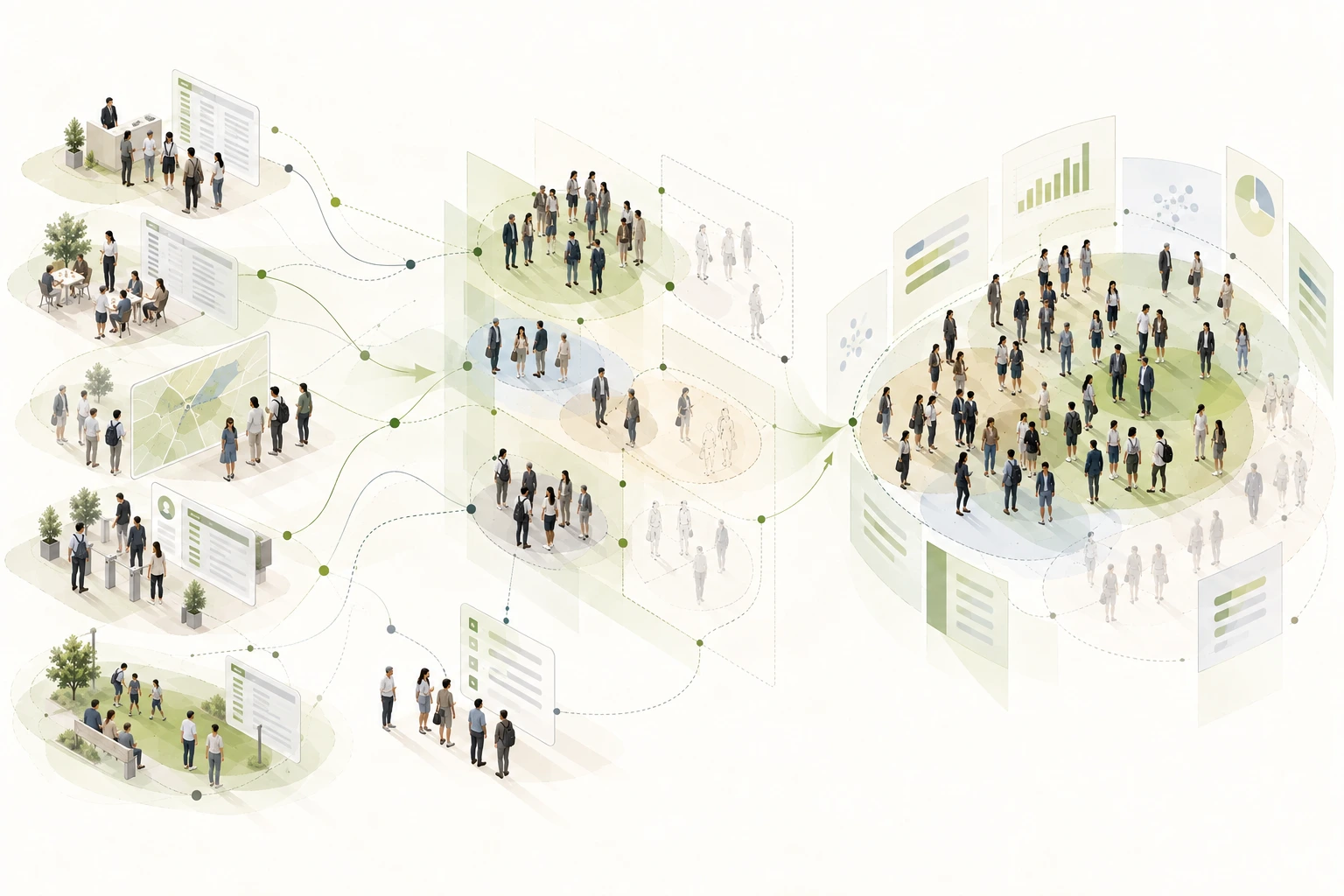
A golf course that has been operating for twenty years probably knows quite a bit about its customers. Management knows which days attract regulars, recognizes long-standing members, sees the companies that return for outings and has a reasonable sense of the communities from which golfers travel.
The course may also have twenty years of data.
Tee-time systems contain reservation histories. Membership records show tenure. Tournament registrations identify organizations and groups. Customer records contain ZIP codes. Point-of-sale systems may capture purchases beyond golf itself.
Despite all of this information, the course may still struggle to answer seemingly basic questions about its audience. What is the age distribution? How many customers are homeowners? What kinds of occupations are represented? What does the household composition look like? How different are frequent customers from occasional visitors?
The problem isn’t necessarily a lack of information. It is that customer knowledge has accumulated for different reasons, in different places and with different levels of support.
Building an Audience Profile begins by bringing some order to that knowledge.
Start with what you already know
The first step is not to launch a survey or build a new customer database. It is to establish what the business already knows and, just as importantly, what it does not.
A reservation system might provide strong evidence about visit frequency while saying nothing about household composition. Membership records may describe long-standing customers well but exclude thousands of occasional visitors. Management may consistently observe that many customers appear to be retirees or professionals without ever having measured either characteristic.
Those are all potentially useful pieces of the audience picture. They are not the same kind of evidence.
The distinction matters because businesses often fill gaps without realizing they are doing it. A course knows that many customers come from affluent communities, so household income gradually becomes part of the assumed customer profile. Staff regularly interact with executives during corporate outings, and before long the audience is described as heavily composed of business decision-makers.
Both conclusions might turn out to be true. Neither has been established by the information described.
An Audience Profile becomes useful when it preserves those boundaries. Customer research may provide characteristics reported directly by members of the audience. Operational records may provide evidence about transactions, visits, tenure, geography or other aspects of the customer relationship. Direct organizational knowledge may capture observations that have not been formally measured. Other characteristics may rest primarily on assumptions or informal inference. Some will simply be unknown.
The point is not to dismiss anything that did not come from a formal study. It is to preserve what supports each conclusion.
A customer who reports an occupation through a survey provides a different kind of evidence from a manager’s impression that many customers work in that profession. A ZIP code in a reservation record establishes something about customer origin; it does not establish the household income or other individual characteristics of the customer simply because those characteristics are common in that ZIP code.
In that sense, the first version of an Audience Profile is partly an inventory of evidence: what appears to be known, what supports it, what remains assumption and what is unknown.
For many businesses, that inventory will reveal an uneven picture. Geography may be well documented because every reservation includes a ZIP code. Frequency may be easy to calculate. Membership tenure may go back years. Age, household composition, occupation, income or interests may barely exist in the records at all.
That unevenness is not necessarily a problem to solve. It is a starting point for deciding which gaps actually matter.
Identify the gaps worth filling
Not every unknown characteristic needs to become known.
A business could collect dozens of additional facts about its customers without becoming meaningfully better at understanding them. The useful question is whether filling a particular gap would improve the Audience Profile or support a decision the business reasonably expects to make.
A golf course may already know where customers come from and how frequently they play but know almost nothing about their household or professional characteristics. Another organization may know a great deal about members’ professions but little about household composition. A venue may understand ticket-buyer geography while knowing relatively little about the broader groups attending with them.
Those gaps create different research needs.
This is an important difference between audience research and simply collecting customer data. It is easy to construct a long list of every characteristic that might someday be interesting. It is harder—and usually more useful—to ask what additional evidence would change the business’s understanding of its audience or make a later analysis more defensible.
That also means an unknown can legitimately remain unknown. If professional context has no plausible analytical or decision-making purpose for a particular organization, collecting it merely to make the profile look more complete adds little value.
More data does not automatically produce better audience intelligence.
The objective is to collect the evidence that matters.
That is the point at which a survey becomes useful.
Use a survey when direct audience evidence is useful
Not every business needs a customer survey, and not every important gap requires one. But when the missing information is best answered directly by the people who make up the audience, a survey can replace assumptions with evidence.
SiiqIQ’s Audience Survey is intended to sit at this point in the process. It provides a structured way to collect information directly from an audience when existing evidence does not answer questions the business has reason to ask.
The questions worth asking depend partly on what is already known.
If reliable customer records already establish geography and visit frequency, there may be little reason to ask respondents to recreate information the business can measure more accurately elsewhere. Survey questions may instead focus on characteristics such as household composition, occupation, education, interests or aspects of the audience relationship that existing systems were never designed to capture.
For most audience-composition research, collecting that information does not require identifying the individual respondent.
A business trying to understand the prevalence of homeownership within its audience does not necessarily need to know that Jane Smith owns her home. It needs evidence about homeownership across the population being studied.
Anonymity, however, does not require every response to be immediately separated into independent aggregate percentages.
There can be analytical value in retaining the relationships among answers provided by the same anonymous respondent. If one respondent reports an age range, homeownership status and household-income range, those answers can remain linked to that anonymous survey response without being linked to a name, email address, phone number, Firebase UID or other direct identity.
That distinction becomes important when the analysis moves beyond individual distributions. Knowing that 60 percent of respondents fall within an age range, 70 percent are homeowners and 30 percent meet an income threshold does not tell us how many respondents satisfy all three conditions. Respondent-level linkage can sometimes support that analysis without requiring identified customer profiles.
The purpose is not to learn everything possible about a particular person. It is to preserve enough structure in anonymous evidence to make legitimate statements about the audience.
The ability to collect a piece of information does not automatically create a reason to collect it, and collecting it does not automatically create a reason to identify the person behind it.
Keep the evidence attached to its context
Suppose a survey of 300 customers finds that 62 percent of respondents are homeowners, 34 percent work in management or professional occupations and 41 percent have interacted with the business for more than five years.
Those findings begin replacing impressions with directly reported evidence.
They also need to retain their context.
Three hundred survey respondents are three hundred survey respondents. They are not automatically a perfect representation of every person who interacts with the business.
A survey sent only to members will naturally tell us more about members than occasional visitors. One distributed through an email list may represent customers who maintain an active email relationship with the organization better than those who do not. Research conducted during a major event may capture a different population from research conducted throughout an entire season. A survey collected during one part of the year may miss seasonal differences that matter to the audience.
This does not invalidate the results. It tells us how to interpret them.
Audience research becomes more credible when the circumstances surrounding the evidence remain visible rather than disappearing once a percentage reaches a chart.
Response or sample count matters. So does the population that was sampled and, where relevant, how and when the evidence was collected. The source of a characteristic matters. How much of the audience is represented—and how much of the profile is supported by available evidence—matters. Important limitations matter.
That does not require attaching a complicated statistical qualification to every number. It requires enough context to understand what a finding represents.
A directly reported customer characteristic should not be presented as equivalent to an informal management estimate simply because both can be expressed as percentages. A finding based on fifteen respondents should not look indistinguishable from one based on fifteen hundred. Evidence drawn from members should not silently become a claim about every visitor.
The objective is not to make imperfect evidence unusable. It is to keep its limitations from disappearing.
Turn the evidence into an understandable Audience Profile
A business can have good evidence and still struggle to understand its audience.
A spreadsheet containing hundreds of survey responses may be analytically useful while making the overall composition difficult to see. Operational records can contain years of customer history without revealing obvious patterns until those records are organized and summarized.
This is where visualization has a role beyond making the results attractive.
An age distribution may show that the audience is much broader than management assumed. Professional information may reveal concentrations that were not obvious through day-to-day interaction. Relationship data may show that occasional visitors substantially outnumber the highly visible regular customers whom staff know personally.
The value of a visualization is not that it converts the data into a prettier format. It allows patterns, concentrations and gaps to be understood more readily.
A useful Audience Profile should help communicate both what the evidence suggests and what evidence supports that view.
Depending on the evidence available, that may mean understanding not only a distribution but also how many observations support it, where the evidence came from, which part of the audience it represents and what remains unknown. Important gaps should remain visible rather than being hidden simply because other portions of the profile are well supported.
If a business has strong evidence about age, geography and customer relationship but almost nothing about professional context, the profile should not create a false sense of completeness. That missing information may eventually be worth collecting. It may also turn out to be irrelevant to any decision the business needs to make.
The profile provides structure for making that distinction.
It also provides a place where different sources of evidence can complement one another without pretending they are interchangeable.
Reservation histories may provide stronger evidence of actual visit frequency than a survey respondent’s recollection. A survey may provide household or professional characteristics that the reservation system was never designed to collect. Customer records may establish geographic origin without being used to assign individuals the demographic characteristics of the places in which they live.
Bringing those sources together is valuable precisely because they tell the business different things.
Use the profile as a starting point, not a conclusion
Audience research does not have to be completed in a single exercise, and an Audience Profile does not need to reach a permanently “complete” state.
A first round of research may answer several important questions while raising others. A business may discover an unexpected concentration of customers from a particular profession. Frequent customers may look different from occasional visitors. Respondents from one market may report much longer relationships with the organization than respondents elsewhere. An audience that seemed relatively uniform may contain several distinct groups.
Those findings can guide the next round of research.
Some may reveal evidence gaps worth filling. Others may lead to questions that require operational records rather than another survey. Some may simply remain interesting observations until enough evidence exists to justify further investigation.
Over time, the Audience Profile can become more informative as evidence improves.
Eventually, that creates possibilities that go well beyond describing the customer base. Once the audience is understood with reasonable evidence, the business can begin investigating whether certain characteristics are associated with stronger customer relationships. It can examine distinctive audience concentrations, geographic patterns or differences among customer groups. It can compare aspects of its audience with surrounding populations.
For organizations that sell advertising or sponsorships, the same foundation can later help prospective advertisers understand the audience associated with an opportunity.
Those are later analytical stages.
The initial Audience Profile does not identify Best Customers simply because it describes the audience. It does not establish why a customer behaves a particular way, prove market opportunity, determine Audience Fit, establish advertiser value or predict campaign effectiveness.
It gives the business a better foundation from which those questions can eventually be investigated.
The first step is considerably less ambitious.
Take what the business already believes about its audience and separate what is supported from what is assumed or unknown. Preserve the evidence already available. Identify the gaps that matter. Collect additional evidence when the value of filling a gap justifies the effort. Then organize that evidence so the audience—and the limits of what is known about it—can be understood.
That is the role of the Audience Profile.
The survey is not the profile, and the profile is not the final analysis.
The survey is one way to replace important unknowns with evidence. The profile gives that evidence structure. What the business learns from it is where audience intelligence begins.
Build your Audience Profile
Start with what you already know about your audience. Create an Audience Profile to define the population you want to understand, then use a survey when direct audience evidence can help fill important gaps.